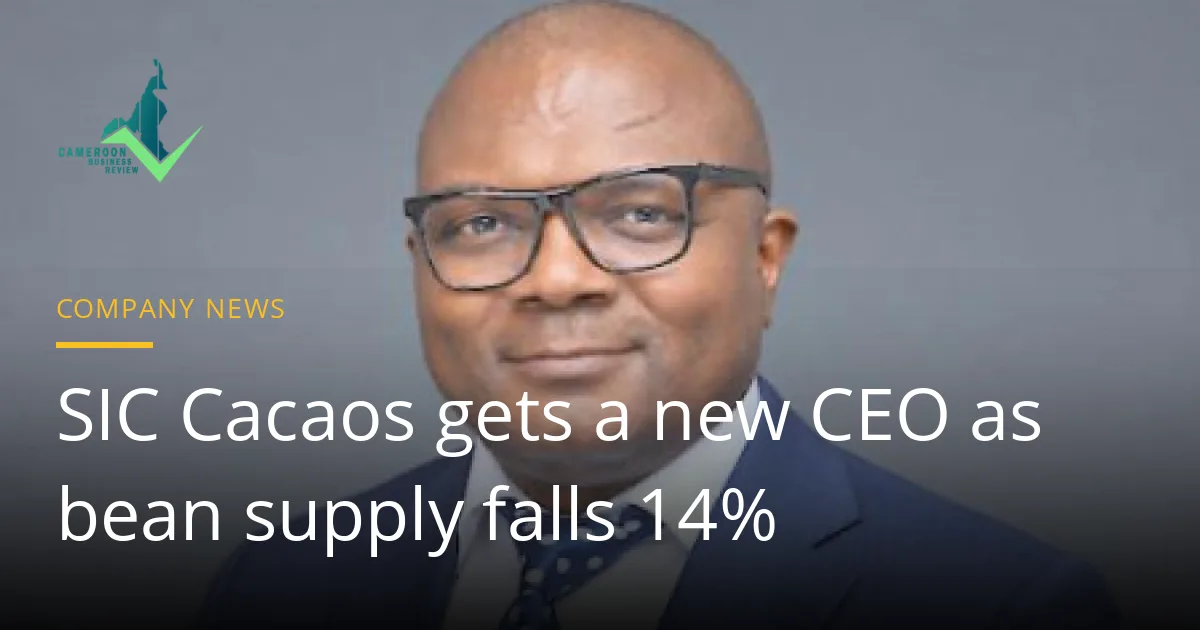
SIC Cacaos, Cameroon's largest industrial cocoa processor, has a new chief executive. Blaise Kengne now runs both the Société industrielle camerounaise des cacaos and Barry Callebaut Cameroon, the Swiss group's local arm. He takes the job as the SIC Cacaos CEO post comes with a harder problem than usual: the plant is getting fewer beans.
Business in Cameroon reported the appointment on 27 October 2026, after Kengne announced it on LinkedIn. Figures from the National Cocoa and Coffee Board (ONCC) show bean deliveries to SIC Cacaos fell by about 14% in the 2025–2026 season.
Who is the new SIC Cacaos CEO
Kengne is not new to the Douala factory. According to Business in Cameroon, he spent several years at SIC Cacaos earlier in his career, working in industrial maintenance, facility management and the operations that receive, store and handle beans.
He comes back from Nigeria, where he had led Barry Callebaut's business since October 2023. He holds an engineering degree from the National Advanced School of Engineering in Yaoundé and an MBA, and has more than 18 years of experience.
That background fits the moment. The immediate challenge at SIC Cacaos is about supply and plant use, which is the part of the business Kengne knows from the inside.
The bean shortfall in numbers
ONCC data for the 2025–2026 season, as reported by Business in Cameroon, show:
- SIC Cacaos received 40,012 tonnes of beans, down from 46,532 tonnes the season before.
- That is a fall of 6,520 tonnes, or roughly 14%.
- Even so, SIC Cacaos still took 41.8% of all beans supplied to industrial processing plants.
- All processors together, industrial and small-scale, handled 95,946 tonnes, down 13% from 110,388 tonnes.
So SIC Cacaos fell roughly in line with the whole sector. The squeeze is not specific to Barry Callebaut. Less cocoa is reaching Cameroon's grinders overall.
How the other processors did
The picture among competitors was mixed. Atlantic Cocoa lost 12,878 tonnes of supply, a far larger drop than SIC Cacaos in absolute terms. Two smaller players gained ground: Neo Industry received 1,286 tonnes more than the year before, and Africa Processing Company 2,485 tonnes more.
Processed output for 2025–2026 was:
- SIC Cacaos: 29,245 tonnes
- Neo Industry: 18,300 tonnes
- Atlantic Cocoa: 16,848 tonnes
- Africa Processing Company: 15,192 tonnes
Business in Cameroon notes that these output figures include finished and intermediate products, so they cannot be compared directly with the tonnes of raw beans received.
A balance sheet that has been rebuilt
The leadership change also follows a period of financial repair at SIC Cacaos. In 2025, the company raised its share capital from CFA2.574 billion to CFA6.885 billion, an increase of CFA4.311 billion. That came after a capital reduction in 2023, which followed a weakening of its equity position.
Public documents do not say what form the 2025 contributions took, or whether the money went into new equipment. That is one of the open questions the new chief executive will face from suppliers and policymakers.
Why bean supply matters for Cameroon
Cameroon has spent years trying to process more of its own cocoa instead of exporting raw beans. Local grinding keeps more of the value in the country and creates industrial jobs in Douala and Kekem. But a grinder only earns money if it runs near capacity, and that depends on beans arriving at the gate.
When local supply tightens, processors compete with exporters for the same beans. Farmers sell to whoever pays most, and in a high-price market exporters can often outbid factories that have to cover energy, labour and equipment costs. A 13% fall in total supply to processors suggests that competition got harder this season.
For readers following prices, our report on cocoa prices paid by Douala exporters explains where farm-gate prices stood in October.
What to watch next
- Purchasing in the 2026–2027 season. The first months of the new main crop will show whether SIC Cacaos wins back volume.
- Use of the 2025 capital. Any announcement of new lines or upgrades would explain where the CFA4.3 billion went.
- Government processing targets. Cameroon's push for more local transformation will depend on grinders like SIC Cacaos staying supplied.
- Competitors. Neo Industry and Africa Processing Company grew while the market shrank. If that continues, SIC Cacaos's 41.8% share will come under pressure.
Kengne has not made public comments on his plans beyond the appointment. Cameroon Business Review will follow the company's purchasing figures as the ONCC publishes them.
Source: Business in Cameroon, 27 October 2026, citing ONCC data.