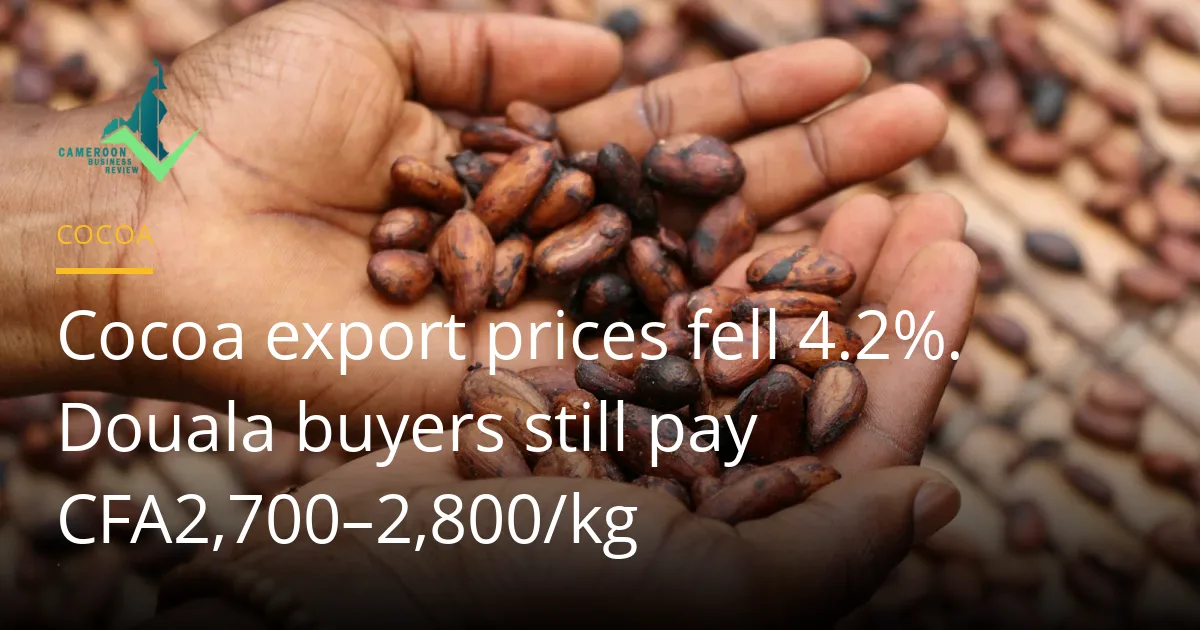
Cameroon cocoa prices paid by exporters in Douala did not move last week, even though the reference price for exported beans fell. Data from the National Cocoa and Coffee Board (ONCC), reported by Business in Cameroon on 22 October, show exporters paying between CFA2,700 and CFA2,800 per kilogram in Douala on 21 October. That range has been unchanged since 7 October.
Over the same week, from 15 to 21 October, the free-on-board (FOB) reference price at Douala fell from CFA3,362 to CFA3,220 per kilogram. That is a drop of CFA142, or 4.2%.
Cameroon cocoa prices: the numbers this week
The figures come from the ONCC's Cocoa and Coffee Sector Information System (SIF).
- Douala exporter purchase price, 21 October: CFA2,700–2,800/kg, unchanged since 7 October.
- Douala purchase price, 1–2 October: CFA2,650–2,700/kg.
- Douala purchase price, 14 July 2026, just before the 2025–2026 season closed: CFA2,700–2,750/kg.
- FOB Douala reference: CFA3,362/kg on 15 October, CFA3,220/kg on 21 October.
- CIF reference (including freight and insurance): CFA3,444/kg falling to CFA3,299/kg over the same week.
Business in Cameroon noted that the July comparison rests on only two market observations, so it should be read with care.
Why buyers did not cut
The gap between the FOB reference and what exporters pay in Douala is their margin for transport, handling, export costs and risk. At the top of the range, that gap narrowed from about CFA562 to about CFA420 per kilogram over the week. Exporters chose to absorb the fall rather than pass it straight down the chain. One likely reason is competition for beans early in the new season, when buyers want to secure volumes. The ONCC data does not say why buyers held their prices, and exporters have not commented publicly.
What farmers actually receive
The Douala price is not the farm-gate price. Beans bought in Douala have already been collected, transported and often graded. Farmers in production areas usually receive less.
The ONCC's statistical report for the 2025–2026 season shows farm-level prices ranging from CFA700 to CFA4,300 per kilogram, with a weighted national average of CFA2,445/kg. That wide range reflects quality, location, timing and the bargaining power of individual farmers and cooperatives.
Cameroon liberalised its cocoa and coffee sector fully in 1995, after reforms that began in 1991. There is no state-set national price. Farmers and buyers negotiate, and the ONCC publishes reference prices for information only. It does not guarantee any income level.
How Cameroon compares with Côte d'Ivoire and Ghana
The two largest producers set regulated farm-gate prices each season:
- Côte d'Ivoire: a minimum guaranteed farm-gate price of CFA1,200/kg for the 2026–2027 main crop, announced on 1 September 2026.
- Ghana: the Ghana Cocoa Board set a producer price of 42,400 cedis per tonne on 25 September 2026, about CFA2,130/kg at the 21 October exchange rate.
Business in Cameroon cautioned that these are regulated producer prices, while Cameroon's figure is a Douala purchase range. The two are not directly comparable. Even so, Cameroon's national farm-level average of CFA2,445/kg last season sits above both neighbours' official prices, which helps explain why cross-border flows of beans are a recurring concern in the region.
What it means for businesses
- Farmers and cooperatives: Douala prices are holding, which gives some bargaining room. Selling through a cooperative that can deliver larger, graded lots usually earns a better price than selling small volumes at the farm gate.
- Exporters: a narrowing margin between purchase and FOB prices leaves less room if world prices fall further. Hedging and forward contracts become more important.
- Processors and lenders: stable purchase prices make it easier to plan working capital for the first months of the season.
Cocoa is central to the government's wider plan to grow agricultural output and cut food imports, which we covered in our report on the CFA1.12 trillion AgriConnect investment pact.
The next ONCC price updates will show whether Douala buyers keep holding the line, or whether a further slide in export prices finally reaches the purchase range.