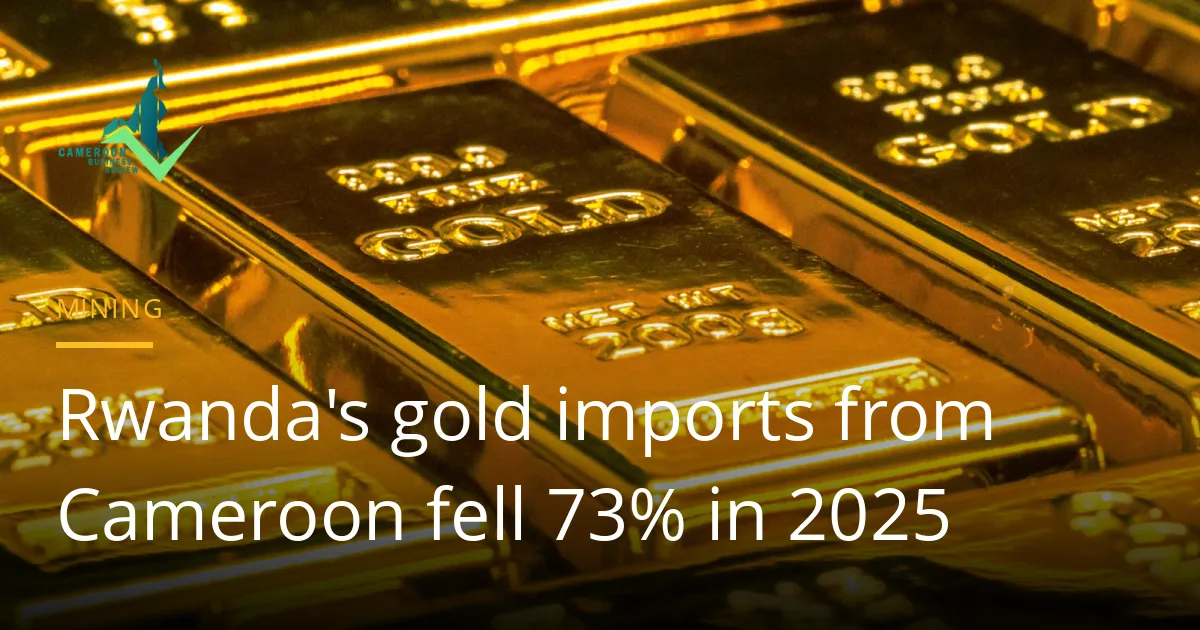
Cameroon gold exports, as recorded by the countries that say they bought them, fell sharply in 2025. Rwanda reported importing 1,817 kg of unwrought non-monetary gold from Cameroon last year, worth $120.26 million, down 73.1% from 6,746 kg in 2024. Uganda reported another 3,321 kg from Cameroon, worth $377.18 million.
The figures come from the World Integrated Trade Solution (WITS) database, which draws on UN Comtrade, and were compiled by Amina Malloum of Business in Cameroon on 22 October. They raise an old question again: Cameroon's own customs service records almost none of this gold leaving the country.
What the Cameroon gold export data show
The numbers below are declarations made by the importing countries under customs code HS 710812, which covers unwrought gold in non-monetary form.
Rwanda
- 2023: 3,060 kg declared as coming from Cameroon.
- 2024: 6,746 kg, valued at $413.13 million.
- 2025: 1,817 kg, valued at $120.26 million, or about CFA67.9 billion at an indicative CFA565 per dollar.
Even after the fall, Cameroon was still Rwanda's largest declared source in 2025, at 39.9% of the $301.1 million Rwanda imported under this code. Tanzania followed with $77.95 million (1,729 kg) and Kenya with $72.62 million (1,341 kg), with smaller amounts attributed to Burkina Faso and South Africa. Rwanda's total imports under the code dropped from $1.54 billion in 2024 to $301.1 million in 2025.
Uganda
- 2024: 3,175 kg from Cameroon, worth $248.18 million.
- 2025: 3,321 kg, worth $377.18 million.
Together, Rwanda and Uganda reported 5,138 kg of gold from Cameroon in 2025, worth $497.44 million, or roughly CFA281 billion.
The gap with Cameroon's own records
Here is the problem. Cameroon's National EITI Committee, in its report on 2023 published in December 2025, says the Directorate General of Customs recorded just 22.31 kg of gold exports in 2023, worth CFA904.14 million. Those shipments went to Italy, the United Arab Emirates, the United States and Portugal. Neither Rwanda nor Uganda appears on the list.
For the same year, mirror data show Rwanda declaring 3,060 kg and Uganda 1,117 kg from Cameroon. The EITI report also cites 15,194 kg attributed to Cameroon by importing countries in 2023 under the broader HS 7108 heading, though that wider code is not directly comparable with the narrower one used for the 2025 figures.
In other words, buyers abroad say they received tonnes of Cameroonian gold, while Cameroon's customs saw kilograms.
Where could the gold be coming from?
The data cannot answer that, and Business in Cameroon is careful to say so. Import declarations do not show how much gold Cameroon actually produced, which routes shipments took, or which companies and traders were involved.
There is relevant context. The Global Initiative Against Transnational Organized Crime (GI-TOC), in a report published on 28 January 2026, said gold from South Kivu in the eastern Democratic Republic of Congo kept flowing into Rwanda, and noted that UN experts have documented Congolese gold smuggling into Rwanda for nearly two decades. Using partial 2024 data, GI-TOC found Rwandan importers reporting supplies from several countries, including Cameroon, but none from the DRC.
That does not prove gold labelled as Cameroonian came from the DRC. It does show why the origin of these declarations matters. Settling it would require matching Rwandan and Ugandan import declarations with Cameroonian customs records, shipping documents and the identities of the traders.
Why this matters for Cameroon's economy
- Lost revenue: gold that leaves without being recorded pays no export duties or royalties. The government wants more revenue from gold in 2027, and every unrecorded kilogram works against that.
- Reputation and finance: mismatched trade data can draw attention from anti-money-laundering bodies and make banks more cautious about the mining sector. That matters at a time when Fitch has already cut Cameroon to B-, as we reported in our Fitch downgrade report.
- Policy credibility: Cameroon is an EITI member, and transparency reports are only useful if customs, mining and trade data line up.
What to watch
- The next EITI report covering 2024, and whether it addresses the mirror-data gap.
- Any response from Cameroon's customs or mines ministry to the 2025 figures.
- Whether Rwanda's and Uganda's 2026 declarations show Cameroon's share shrinking further or shifting to other countries.
For now, the clearest conclusion is a narrow one: the gold that other countries say came from Cameroon is not showing up in Cameroon's own export statistics.