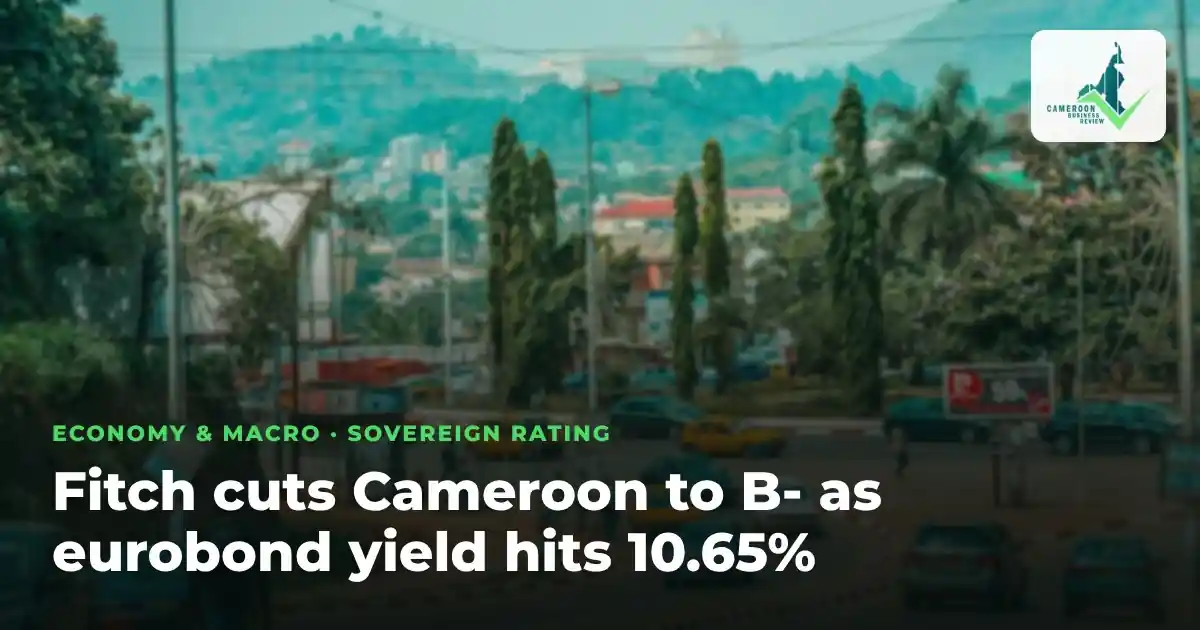
Fitch Ratings has cut Cameroon's long-term sovereign rating by one notch, from B to B-, with a stable outlook. The Fitch downgrade was announced late on Friday 16 October, and by Monday the yield on Cameroon's 2033 eurobond had climbed to a record 10.65%, according to Briefs Finance, citing Bloomberg data.
The agency gave two reasons. The first is political: the risk of what it called a disorderly transition of power. The second is money: financing has become harder to find, including in the regional CEMAC market where Yaoundé raises much of its domestic debt.
The decision came about ten days after Cameroon added $300 million to its 2033 eurobond, EcoMatin reported.
Why Fitch cut the rating
President Paul Biya is 93. He won an eighth term in October 2025 and has not named a successor. A constitutional reform signed in April 2026 restored the post of vice-president, abolished in 1972, but nobody has been appointed to it. Fitch's concern is that a successor could struggle to establish authority if the handover is sudden or contested.
On financing, Fitch does not expect Cameroon to have an IMF programme before 2028, because the government did not request a new one in 2026, EcoMatin reported. The previous programme ended in July 2025. Without it, Yaoundé leans more on market borrowing, which is now more expensive.
Fitch also pointed to longer-running weaknesses:
- Arrears. Outstanding government payables stood at CFA703.5 billion at the end of June 2026, according to the Autonomous Sinking Fund (CAA), as cited by EcoMatin.
- Banks and the state. Lending to governments rose from about 10% of bank assets in 2015 to about 30% in 2025. That limits how much more local banks can absorb.
- External accounts. The current account deficit is expected to widen to 5% of GDP in 2026 as cocoa prices fall.
- Fragility. The IMF and World Bank both classify Cameroon as a fragile and conflict-affected state.
Briefs Finance reported that Fitch expects gross financing needs to rise to 7.3% of GDP in 2026, from 5% in 2025.
What still holds up
The downgrade is not a verdict on the size of Cameroon's debt. By the numbers Fitch uses, public debt is lower than at most countries with a similar rating.
- Public debt was 42.5% of GDP at the end of 2025 and is projected to fall to 39.1% by 2028. The median for B-rated sovereigns is 56%.
- The 2026 budget deficit is forecast at 2.2% of GDP.
- Real growth is projected at 3.7% in 2026 and 2027 and 4.1% in 2028, slightly below the 4.3% median for B-rated peers.
- Inflation should stay near 3% in 2026, helped by fuel subsidies.
In other words, the agency is pricing in the risk around how Cameroon is governed and funded, rather than a debt burden that is already too heavy. Its list of weaknesses includes weak governance indicators, low income per head and gaps in public finance management.
How the bond market reacted
Investors had already been selling before Fitch acted. On Monday 19 October, the 2033 notes were up nearly 30 basis points to 10.65%, a record, and the 2031 notes were up 20 basis points to 10%, Briefs Finance reported. It was the fourth straight daily rise. The two bonds have about $1.7 billion outstanding between them, so trading is thin and prices can move quickly.
The selling started earlier in the year. In August, EcoMatin reported that the 2033 bond had slipped from about 101% of face value to 96.85% after the president left for Switzerland on 7 June, while Cameroon's bonds on the regional BVMAC exchange kept trading at par. Local investors have so far treated repayment risk as low, partly because of the central bank's automatic debit mechanism for debt service, a broker told EcoMatin.
That gap matters for the budget. A borrower paying more than 10% in dollars has a strong reason to raise money at home instead. But Fitch's point about bank exposure suggests local lenders are close to their limits.
What would move the rating again
Fitch listed the triggers in both directions, according to EcoMatin:
- Further downgrade: clear political or security instability, or a wider deficit combined with financing strain.
- Upgrade: a clearer succession process, or better access to concessional financing.
What it means for companies and the budget
A B- rating raises the floor for what Cameroonian borrowers pay abroad. State-linked firms and banks that price off the sovereign will feel it first. The government's own plans are exposed too. EcoMatin reported in August that a planned $692 million ESG bond would test whether investors would charge more, and the downgrade makes that test harder.
The cheapest money on offer remains development finance. The World Bank has approved about $5 billion for Cameroon, of which $4.13 billion has been signed, as we reported last week. Fitch's upgrade trigger points in the same direction: more concessional funding would ease the pressure.
Paying down arrears would also help. The CFA703.5 billion owed at the end of June is money that suppliers and contractors are waiting for, and it ties up working capital across the private sector.
Fitch had been the most generous of the three big agencies, EcoMatin noted in earlier coverage; that cushion is now thinner. The vice-presidency is the most visible open question. Until it is filled, investors are likely to keep demanding a higher return to hold Cameroon's debt.