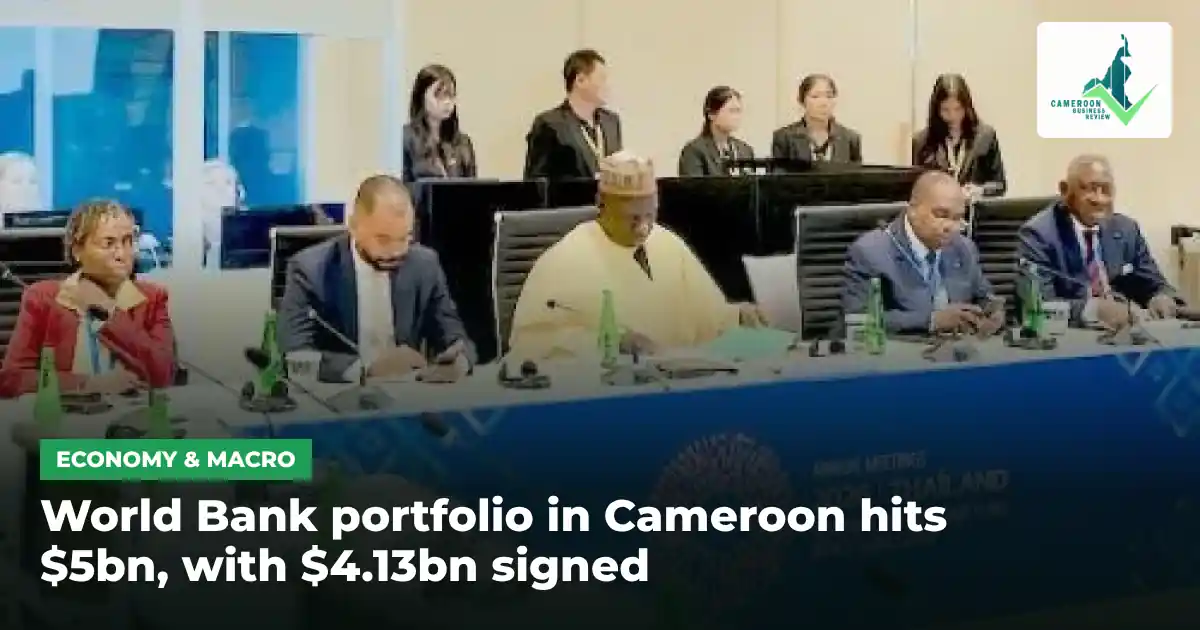
World Bank financing for Cameroon now stands at $5.01 billion in approved commitments spread across 21 projects, according to figures Cameroon's Ministry of the Economy (MINEPAT) presented at the IMF and World Bank Annual Meetings in Bangkok on 15 October. Of that total, financing agreements worth $4.129 billion have been signed for 18 active projects.
The numbers, reported by Business in Cameroon, make the World Bank one of Yaounde's largest sources of development money. They also raise a question the government itself put on the table in Bangkok: how quickly that money turns into roads, power lines and services.
World Bank Cameroon portfolio: what the figures show
MINEPAT's statement breaks down as follows:
- Approved financing: $5.01 billion for 21 projects, 15 of them national and 6 regional.
- Signed agreements: $4.129 billion covering 18 active projects.
- Gap between the two: about $881 million.
The ministry did not publish a project-by-project list. Business in Cameroon notes that the $881 million gap does not necessarily mean money is sitting unsigned or undisbursed. It may reflect timing, regional operations that are counted differently, or projects at different stages of approval.
A currency puzzle in the official numbers
MINEPAT also gave CFA franc equivalents: CFA2.915 trillion for approved financing and CFA2.271 trillion for signed agreements, a difference of CFA644 billion. Business in Cameroon points out that these imply two different exchange rates, roughly CFA582 and CFA550 to the dollar, which do not match each other.
At the Bank of Central African States (BEAC) indicative rate of CFA583.2579 per dollar on 14 October, the $881 million gap would be worth about CFA514 billion, not CFA644 billion. For readers tracking public debt and project finance in CFA francs, that difference is large enough to matter.
The Douala-Bangui corridor is the clearest example
One project shows how approval and signature can sit weeks or months apart. The World Bank approved the Douala-Bangui Economic Corridor on 12 June 2026, with $425 million in financing, about CFA248 billion at the 14 October rate. That package combines:
- a $407 million loan from the International Bank for Reconstruction and Development (IBRD); and
- an $18 million credit from the International Development Association (IDA).
As of 30 September, the World Bank's database still listed the project as "Approved." A presidential decree dated 2 October authorised the signing of the IBRD credit agreement. As Business in Cameroon notes, authorisation is not proof the agreement has been executed, so it is not yet clear whether it was signed before the Bangkok figures were released.
Comparing the numbers with September
The Bangkok figures follow two earlier snapshots that are hard to reconcile with them:
- On 9 September, MINEPAT estimated the portfolio at $3.2 billion, or about CFA1.806 trillion, without listing which operations it included.
- On 10 September, the World Bank listed 22 active projects in Cameroon, including six regional ones.
- On 15 October, MINEPAT reported $5.01 billion approved and $4.129 billion signed.
Because each count used a different scope, the jump from $3.2 billion to $5.01 billion cannot be read as new money arriving in a single month.
Disbursement is the real test
Neither the government nor the World Bank has published how much of the current portfolio remains undisbursed. The most recent indication comes from an earlier Business in Cameroon analysis of 21 World Bank-financed projects, which had a disbursement rate of 18.7% as of 30 June 2026. That figure covered a different set of projects and cannot be applied directly to the October totals, but it points to a familiar problem: approved money moving slowly.
In Bangkok, the government asked the World Bank for three things:
- shorter processing times for "no-objection" approvals, which the Bank must give at certain procurement stages;
- stronger support for the project management units that run the programmes on the ground; and
- room to reallocate financing towards better-performing projects, an option MINEPAT says it is considering, without naming projects or amounts.
Why it matters for Cameroon's budget
Concessional project money matters more when domestic resources are stretched, and they are. The government is spending heavily to hold fuel prices steady, as we reported when it spent CFA57 billion in a single month on fuel subsidies. When approved loans are executed slowly, the country waits longer for the infrastructure the money was meant to build, and some loans carry charges on balances that have not yet been drawn.
For businesses, the practical signal is in the pipeline of tenders. Contractors, engineering firms and suppliers will want to watch which of the 18 signed projects move into procurement next, and whether the Douala-Bangui corridor agreement is formally executed before the end of the year.
A published, project-level list of what has been approved, signed and paid out would make it much easier for Cameroonians to judge how quickly this money is being put to work.