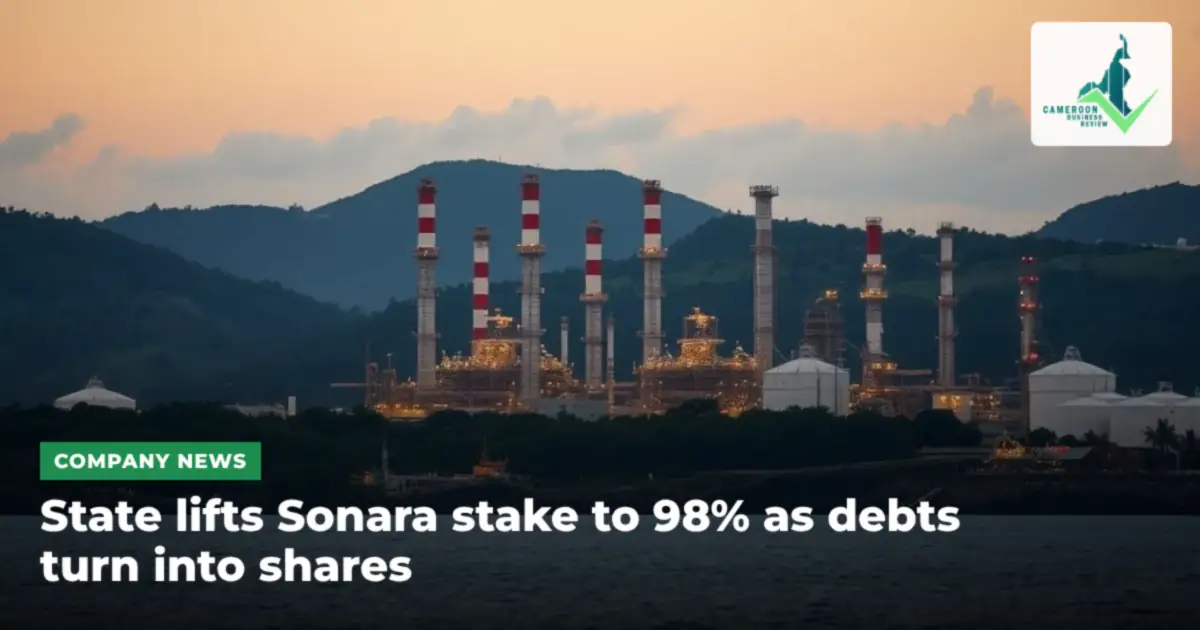
The government of Cameroon now owns 98.09% of Sonara, the national oil refining company, after a capital restructuring that shrank every other shareholder to a token stake. TotalEnergies Marketing Afrique, once a 4% holder, is left with 0.42%. The figures were published by Business in Cameroon, in a report by Baudouin Enama on October 16, based on a notarised legal notice.
The operation did not bring in fresh cash. It turned money the state was owed by Sonara into shares, a common tool when a public company's balance sheet has been badly damaged.
How the Sonara shareholding changed
Before the operation, the state held 81.95% of the refinery. Four other public or semi-public shareholders held the rest alongside TotalEnergies. After it, the picture looks like this, according to Business in Cameroon:
- State of Cameroon: 81.95% to 98.09%
- TotalEnergies Marketing Afrique: 4% to 0.42% (13,592 shares)
- SNH, the national hydrocarbons company: 6.06% to 0.64%
- CSPH, the hydrocarbon price stabilisation fund: 4.22% to 0.45%
- SNI, the national investment company: 3.77% to 0.40%
Sonara's share capital now consists of 3,216,058 shares, of which the state owns 3,154,660. Public-sector holders together own 99.58%, compared with 96% recorded in the 2023 report of the Extractive Industries Transparency Initiative (EITI). The four non-state holders combined fell from 18.05% to 1.91%.
The legal timeline
Shareholders approved the operation at an extraordinary general meeting on June 17, 2026. The notarised notice that made it public was filed in Limbe on October 14, 2026.
A "coup d'accordéon" in three steps
Lawyers call this type of operation a coup d'accordéon: capital is reduced to absorb losses, raised again, then adjusted. Business in Cameroon set out the sequence:
- Sonara cancelled 278,777 shares, worth CFA16.03 billion.
- It issued 6,628,200 new shares at CFA57,500 each, worth CFA381.12 billion, reserved for the state.
- It then cancelled a further 3,473,540 shares, worth CFA199.73 billion.
The two cancellations total CFA215.76 billion. Net of the new issue, share capital rose from CFA19.56 billion to CFA184.92 billion, an increase of CFA165.36 billion.
The new shares were paid for by offsetting claims the state held against Sonara. In plain terms, the government swapped debt for equity. The refinery's cash position did not improve as a result, but its liabilities to the state fell.
What minority shareholders lose
The dilution has legal consequences beyond the percentages. Under Article 159 of the OHADA Uniform Act on commercial companies, shareholders holding at least 10% of capital have certain rights, including the ability to ask for some court-ordered measures. With the four other holders now at 1.91% combined, Business in Cameroon notes that they can no longer reach that threshold, even acting together.
For TotalEnergies, the change is mostly symbolic. Its marketing arm remains a shareholder, but with 13,592 shares it has no meaningful say in how the refinery is run.
Why the state is cleaning up Sonara now
Sonara's 42,000 barrels-per-day refinery in Limbe has been idle since a fire in May 2019, according to Argus. Since then, Cameroon has imported refined fuel and paid heavily to keep pump prices stable, a cost we examined in our analysis of the CFA57 billion spent in one month on fuel price support.
The government is targeting a restart in December 2027, according to Argus and industry outlet Worldports. A technical assessment by French engineering firm Ekium estimated that 75% of the refinery's capacity can be recovered, 8% is lost and 17% still needs to be checked.
A cleaner balance sheet for a restart
A restart needs financing, and lenders look at balance sheets. Turning state claims into equity reduces Sonara's debt and gives the government near-total control over decisions on rehabilitation, partners and funding. It also means the state carries almost all of the risk if the restart slips.
What to watch
- Whether the government announces financing or a technical partner for the Limbe rehabilitation
- Progress on the 17% of capacity Ekium has yet to assess
- Whether the December 2027 restart target holds
The restructuring settles who owns Sonara. Whether that ownership produces a working refinery, and an end to costly fuel imports, depends on decisions still to come.