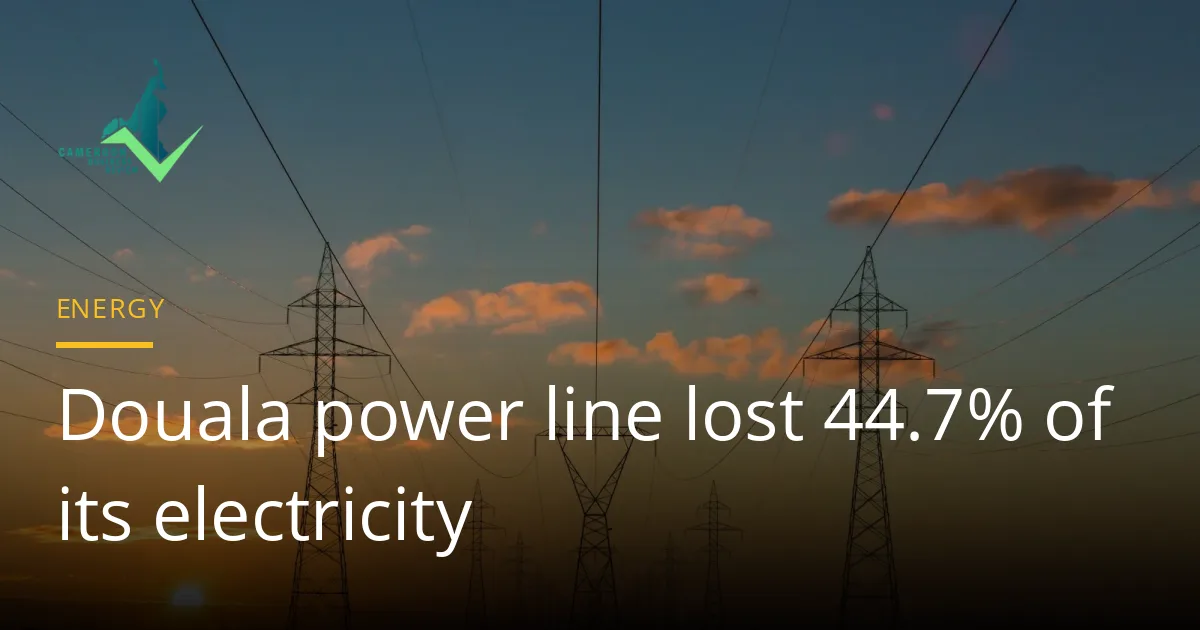
Electricity losses on one high-voltage line in Douala reached 44.7% in November 2025, nearly nine times the level Cameroon's power regulator considers acceptable. The figure comes from the 2025 annual activity report of the Electricity Sector Regulatory Agency (ARSEL), reported on 23 October by Business in Cameroon.
The line in question, the 90 kV Logbaba–Bassa 1 link, is only about 4 km long. Yet in a single month it lost 22,326 MWh, according to ARSEL. The regulator does not yet know how much of that energy actually disappeared and how much is a metering error, and that uncertainty is part of the story.
What ARSEL found on electricity losses
- Logbaba–Bassa 1 (90 kV, Douala): active power loss of 44.7% in November 2025, or 22,326 MWh. ARSEL's acceptable technical threshold is 5%.
- Same line, May 2025: 10,258 MWh lost, a loss rate of 14.7%, already almost three times the limit.
- Garoua–Guider (90 kV, North region): loss rates between 8.2% and 18.9% over six consecutive months.
- Line length: 4.131 km for Logbaba–Bassa 1, according to an infrastructure inventory the National Electricity Transmission Company (Sonatrel) published in a March 2025 tender document.
For context, ARSEL puts Cameroon's overall transmission efficiency at 94.6% in 2025. On that basis the regulator treats the Douala and Garoua readings as local irregularities rather than a system-wide failure.
Real losses or bad meters?
ARSEL gives two possible explanations, and it does not choose between them.
Physical problems on the network
Lines can lose energy as heat when they are undersized for the load they carry, when equipment is old or when conductors are in poor condition. A short urban line in Cameroon's industrial capital carrying heavy demand would be exposed to all three.
Measurement problems
The other explanation is that the energy never went missing. Meters at each end of a line that are not synchronised, or that are badly calibrated, can show a gap that does not exist. A loss rate that jumps from 14.7% in May to 44.7% in November on the same short line is the kind of swing that makes analysts suspect the instruments.
Until audits are done, ARSEL says it cannot separate the two.
What the regulator wants Sonatrel to do
ARSEL's recommendations to Sonatrel are specific:
- Audit the metering systems on the Logbaba–Bassa 1, Garoua–Guider and Bekoko–Nkongsamba 1 lines.
- Inspect, recalibrate or replace faulty meters.
- Carry out technical studies on lines with persistently high losses to decide whether they need upgrades or extra capacity.
The report does not put a cost on the losses, does not say whether Sonatrel has started the audits and does not give a timetable.
Why it matters for businesses
Douala is where most of Cameroon's factories, port activity and large commercial users sit. Energy lost or mismeasured on the transmission grid has to be paid for somewhere in the chain, whether through tariffs, subsidies or the finances of the state utilities. That chain is already under strain. Distributor Socadel owed independent producer Globeleq CFA147 billion for power from the Kribi and Dibamba plants at the end of 2025, up 38%, as we reported in our analysis of Globeleq's arrears.
If the losses are real, fixing a 4 km line in Douala could recover a meaningful amount of energy for relatively little investment. If they are metering errors, the immediate risk is to billing and planning: a transmission company and a regulator that cannot trust their own readings will struggle to settle accounts between producers, Sonatrel and distributors, or to decide where new lines are needed.
What to watch
- Whether Sonatrel publishes the results of the metering audits ARSEL has asked for.
- Loss figures for 2026 on the three named lines.
- Any link ARSEL draws between transmission losses and the next tariff review.
Source: ARSEL 2025 annual activity report, as reported by Business in Cameroon (Amina Malloum), 23 October 2026.