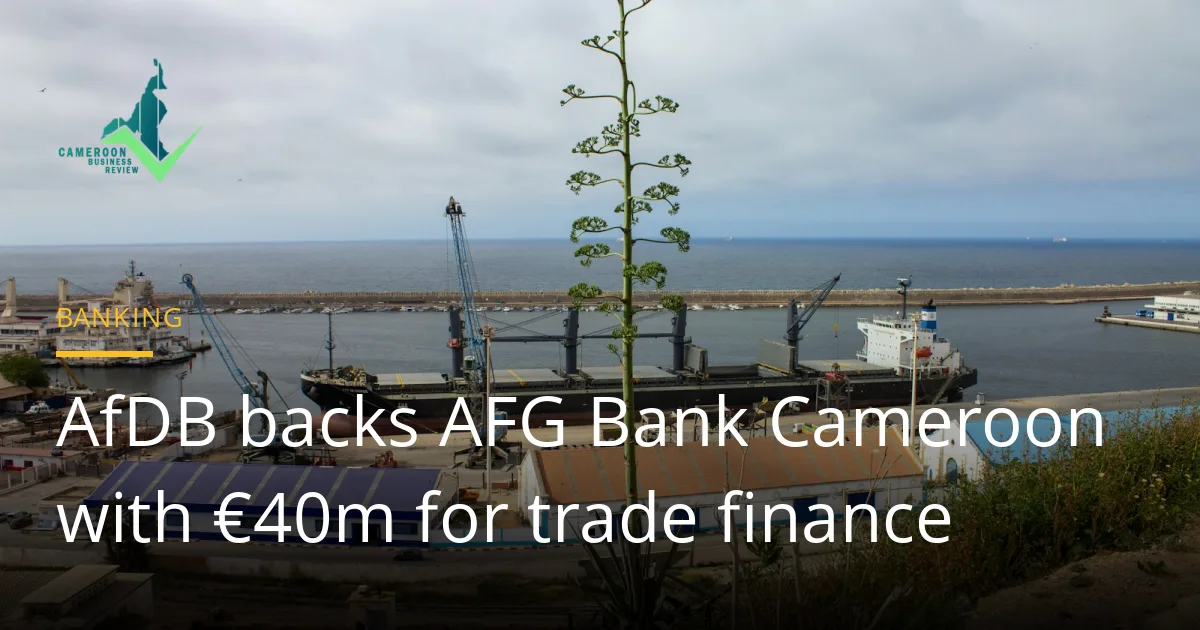
AFG Bank Cameroon has secured a €40 million financing package from the African Development Bank (AfDB) to support companies that import and export. The AfDB Group approved the deal on 21 October, according to Investir au Cameroun. It combines a €30 million trade finance credit line, worth about CFA19.7 billion, with a €10 million guarantee, worth about CFA6.6 billion. Together that is roughly CFA26.2 billion.
Half of the credit line is reserved for small and medium-sized enterprises, and part of that share is earmarked for businesses owned by women or young people. For Cameroonian firms that struggle to get letters of credit accepted abroad, the guarantee may matter even more than the cash.
What the AFG Bank Cameroon package contains
| Instrument | Amount | CFA equivalent | Term |
|---|---|---|---|
| Trade finance credit line | €30 million | about CFA19.7 billion | 3.5 years, with a 3-year grace period on repayment |
| Guarantee mechanism | €10 million | about CFA6.6 billion | 5 years, covering up to 100% of the risk on certain trade operations |
| Total | €40 million | about CFA26.2 billion |
The CFA figures follow from the fixed euro peg of 655.957 CFA francs per euro.
Who the money is for
According to Investir au Cameroun, the credit line will finance companies involved in international trade, with priority for:
- agro-industry and agribusiness,
- manufacturing,
- import and export businesses.
The money can pay for machinery, equipment and production inputs bought abroad.
Half of the credit line, about CFA9.84 billion, is reserved for SMEs. Of that SME share, 30%, about CFA2.95 billion, is earmarked for companies owned by women or young people. Investir au Cameroun attributes that allocation to Eric Valery Zoa, managing director of AFG Bank Cameroon.
Why the guarantee matters for importers
When a Cameroonian company buys equipment from a supplier in Europe or Asia, the supplier often wants a letter of credit: a promise from the buyer's bank that it will be paid if the paperwork is in order. Many foreign suppliers will only accept that promise if a bank they trust "confirms" it, adding its own guarantee.
Foreign banks charge for that confirmation, and some refuse it when they see a bank in a country with a weak credit rating. Cameroon was downgraded to B- by Fitch this month, as we reported in Fitch Downgrade Takes Cameroon to B-. That makes confirmation harder and dearer for every bank in the country.
The AfDB guarantee is designed to fix that. By covering up to 100% of the risk on certain operations, it lowers the risk for the foreign bank that confirms AFG Bank's letters of credit. In practice that should mean:
- more foreign banks willing to confirm,
- lower confirmation fees passed on to the importer,
- faster deals for firms that need imported inputs to produce.
A pattern of AfDB trade deals with Cameroonian banks
This is not the first such operation. On 1 December 2025 the AfDB approved a similar €25 million package, about CFA16.4 billion, for CCA-Bank Cameroun: a €15 million credit line plus a €10 million guarantee. The AFG deal is larger and follows the same model, using a local bank as the channel to reach companies the AfDB could not lend to directly.
AFG Bank Cameroon is one of the larger lenders in the market. The bank said its total assets passed CFA1,500 billion, about $2.6 billion, in 2025, with net profit of CFA255 billion, according to Financial Afrik.
What is still not known
Several points that matter to borrowers have not been disclosed:
- Price. Neither the cost of the AfDB line to AFG Bank nor the rate client companies will pay has been published.
- Timing. No date has been given for when the money will be available to borrowers.
- Results. The AfDB expects higher local production, fewer imported finished goods and more exports. Those are objectives, and they depend on the operations actually financed.
What it means for Cameroonian businesses
For an SME that imports machinery, packaging or raw materials, the practical step is to ask AFG Bank about the new trade finance window and the SME allocation, and to compare its letter-of-credit costs with current offers. Women- and youth-owned firms should ask specifically about the 30% earmark within the SME share.
For the wider economy, the deal is a small but useful offset to tight credit conditions. Bank lending to companies has been sluggish, as figures from Access Bank Cameroon showed last month, and the sovereign downgrade raises the cost of foreign funding. Development-bank guarantees are one of the few tools that can bring that cost down for private firms.
The figure to watch is how much of the CFA9.84 billion SME share is actually lent in the first year.