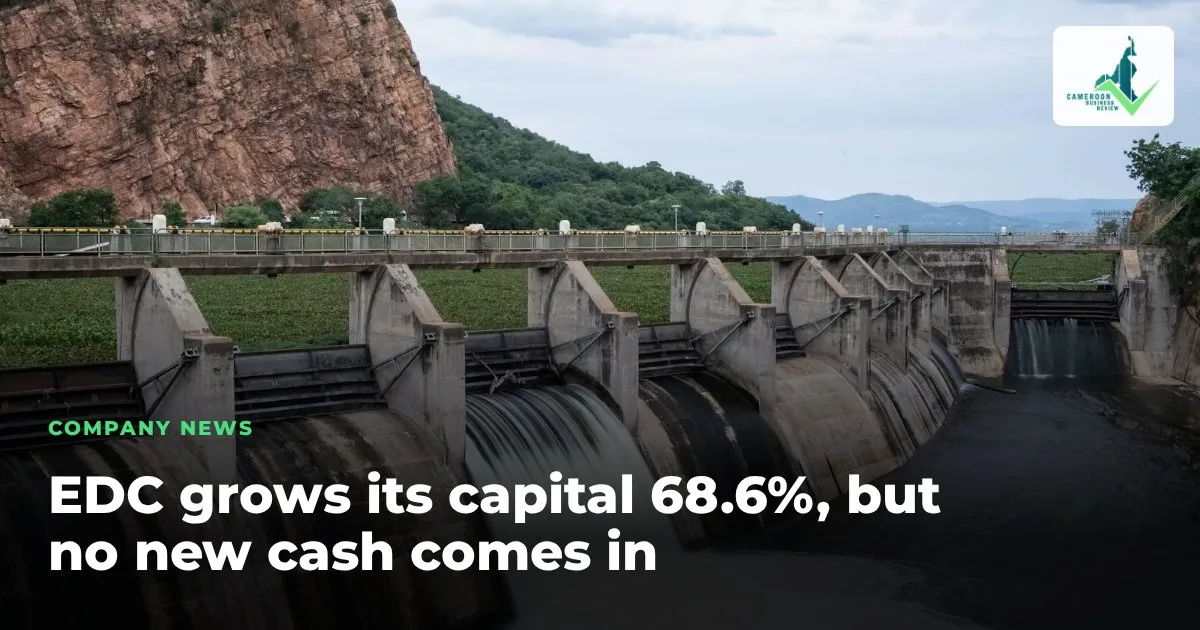
Cameroon's Electricity Development Corporation (EDC) has raised its share capital from CFA15 billion to CFA25.289 billion, an increase of 68.6%. The EDC capital increase did not bring a single franc of new money into the company. It was done by converting government funds that EDC received more than 15 years ago into shares, according to a legal notice published in Cameroon Tribune and reported by Baudouin Enama at Business in Cameroon on 20 October.
For a state company whose cash at the end of 2025 stood at just CFA81.3 million, the difference between a stronger balance sheet on paper and real liquidity is the main story.
How the EDC capital increase was done
The operation added CFA10.289 billion to EDC's capital. It was structured as a debt-to-equity conversion. The money being converted had already been paid to EDC by the Ministry of Finance between 2008 and 2010, when the company was starting operations.
The conversion created 1,028,900 new shares, each with a nominal value of CFA10,000. Business in Cameroon states plainly that the transaction "does not represent new state financing."
A process that took five years
The paper trail shows how slowly the decision moved through the state's systems:
- 2008 to 2010: the Ministry of Finance pays the funds to EDC.
- 2021: EDC's board adopts Resolution No. 167/CA/EDC/2021, proposing to convert the full CFA10.289 billion into share capital, and asks the ministry for approval.
- 16 May 2024: the Ministry of Finance authorises the transaction.
- 31 December 2025: EDC's balance sheet already shows the higher capital. The Directorate General of Budget publishes it on 30 June 2026.
- 7 October 2026: the request to update the company's registration is filed at the registry of the Yaoundé-Centre Administratif Court of First Instance.
The accounting questions
The way the money has been recorded over the years is less tidy than the final result. According to Business in Cameroon's reading of EDC's published accounts:
- EDC first booked the funds as investment grants. Its auditors later questioned that classification.
- At the end of 2023, the CFA10.289 billion was still listed as investment grants.
- In the 2024 comparative figures, investment grants showed zero, while share capital stayed at CFA15 billion.
- The amount appeared under share capital only in the 2025 accounts.
The public documents do not explain how the classification changed between those years. There is also a mismatch in the cash flow statement. The 2025 statement labels the CFA10.289 billion as a "capital increase through new contributions," while the 2024 comparative column shows a negative CFA10.289 billion under investment grants received. Business in Cameroon says these entries need to be reconciled.
Calling the amount "new contributions" is hard to square with the legal notice, which describes a conversion of money received years earlier.
The cash problem behind the numbers
EDC's net cash fell from CFA736.6 million at the start of 2025 to CFA81.3 million at the end of the year, a drop of almost 89%. A higher capital figure improves ratios such as debt to equity, which can help when a company negotiates with lenders. It does not pay bills.
That matters because EDC is the state's vehicle for developing electricity infrastructure. A company with that mission and less than CFA100 million in cash has very little room to fund studies, maintenance or its share of new projects without further support from the Treasury.
Why a debt-to-equity conversion still matters
It would be wrong to dismiss the operation as purely cosmetic. Converting old state funds into capital clears up a question that had hung over EDC's accounts for years: whether the CFA10.289 billion was a grant, a loan or an investment. Once it is recorded as equity, the state's ownership stake reflects money it actually put in, and the company no longer carries an ambiguous item that auditors have flagged.
A larger capital base can also matter for legal and regulatory thresholds. Some financing agreements and procurement rules look at a company's equity when deciding how much it can borrow or which contracts it can take on. On that measure, EDC now looks considerably stronger than it did on paper a year ago, even though its bank balance tells a different story.
What it means for Cameroon's power sector
The EDC operation comes at a time when public finances are tight. Earlier this week we reported that Fitch cut Cameroon's rating to B- as Eurobond yields hit a record, which limits how much new money the state can put into its companies.
For businesses and investors, three points stand out:
- Recapitalisation on paper. EDC looks better capitalised than before, but the extra capital is not money it can spend.
- Disclosure gaps. The unexplained reclassification and the cash flow labels are the kind of issues that partners and lenders will ask about before working with EDC.
- Funding still needed. Any new EDC role in power projects will still need cash from the budget, development lenders or private partners.
The capital increase closes an accounting file that has been open since 2010. Whether EDC can fund its work in the years ahead is a separate question, and the 2025 cash figure suggests it is not yet answered.