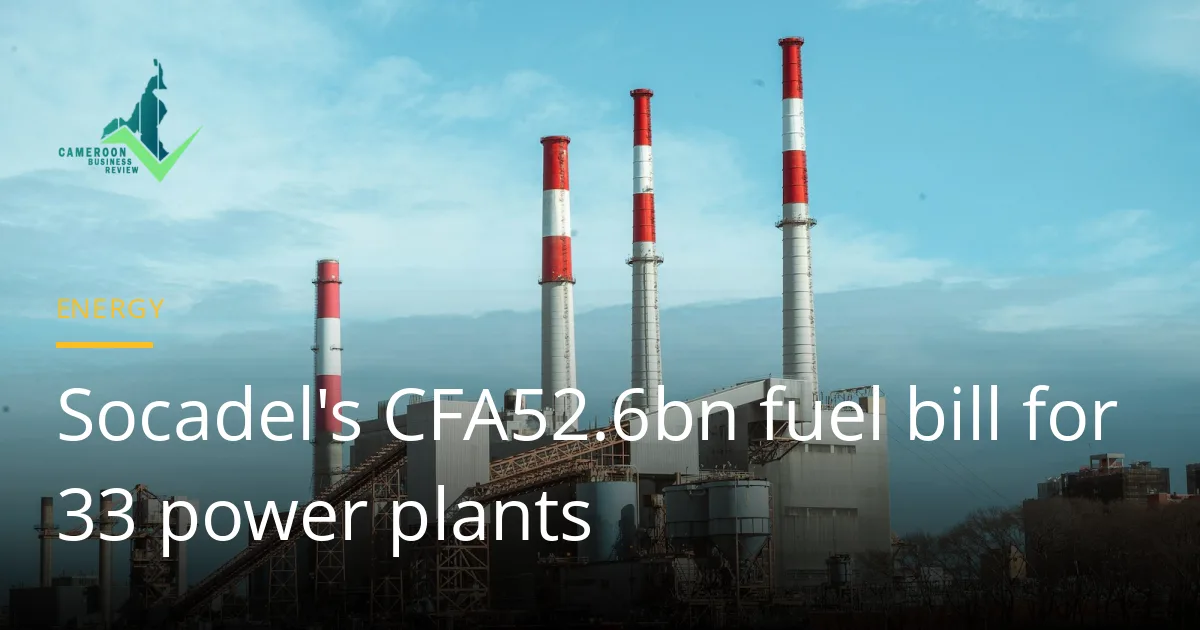
Cameroon's state electricity company Socadel has put out a fuel tender worth an estimated CFA52.622 billion, including taxes, to buy heavy fuel oil and diesel for 33 thermal power plants across the country. The two calls, dated 13 October and published on 19 October by the Public Procurement Regulatory Agency (ARMP), close on 3 November, Business in Cameroon reports.
The figure is an estimate of what the purchases will cost, not money already spent. Even so, it gives a rare line-by-line view of how much of Cameroon's electricity still depends on burning imported fuel, and of which regions lean on it most.
What the Socadel fuel tender covers
The procurement is split in two. Funding comes from Socadel's own budgets for 2026 and 2027, depending on the contract.
Heavy fuel oil: CFA36.715 billion
The larger tender is for HFO 3500, a heavy fuel oil, for four plants: Limbé, Dibamba, Oyomabang and Logbaba. It has two lots:
- Lot 1: CFA17.384 billion, for the Limbé plant alone.
- Lot 2: CFA19.331 billion, for Dibamba, Oyomabang and Logbaba.
The minimum combined supply is 35,327 metric tonnes, with an indicative maximum of 70,653 tonnes. Deliveries follow purchase orders from Socadel under a framework agreement that runs for 15 months from the order to start.
Diesel: CFA15.907 billion
The second tender buys light fuel oil, or diesel, for 29 smaller thermal plants, split into seven lots. Socadel expects to need between about 8.94 million and 17.87 million litres, depending on demand. This contract must be completed within four months using 2026 funds.
The North dominates. One lot covering Djamboutou, Guider, Kousseri and Maroua is valued at CFA9.519 billion, or 59.8% of the diesel budget, for 4.83 million to 9.66 million litres. The second-largest lot, CFA2.109 billion, covers Banyo, Tignère, Touboro, Ngaoundéré, Garoua-Boulaï and Ngaoundal. The remaining five lots serve plants in the Centre, East, South, Northwest and Southwest regions.
Who can bid
The conditions favour large, well-capitalised fuel distributors. For the heavy fuel oil lots, bidders must show:
- a bank certificate proving financing capacity of at least CFA5 billion,
- average annual revenue of at least CFA10 billion over the last three audited years,
- adequate storage and a permanent physical stock of at least 4,000 tonnes, and
- arrangements for transport, shipment tracking and fuel quality control.
Diesel suppliers face a different burden. They must finance the purchase, storage, transport and delivery themselves, with no advance payment from Socadel, and prove financial resources and revenue in line with the lots they bid for.
That last condition matters for local businesses. A supplier carrying several billion francs of fuel on its own balance sheet is exposed to how fast the state utility pays. Cameroon's payment arrears to suppliers have been a recurring complaint, and bidders will price that risk in.
Why the North needs so much diesel
The weight of northern plants in the diesel budget reflects the fragility of the Northern Interconnected Grid. That network relies heavily on the Lagdo dam, which is fed by the Benue River basin. When water levels fall, output drops and diesel generators fill the gap.
Socadel is adding capacity there too. A separate tender dated 4 October, estimated at CFA9.361 billion, covers 10 MW of extra thermal capacity at Djamboutou, Maroua and Ngaoundéré, according to Business in Cameroon. The stated goal is to reduce shortages on the northern grid during the low-water season.
What it means for business and public finances
For companies, the tender is both an opportunity and a signal.
- A large contract for fuel distributors. Lots worth CFA17 billion and CFA19 billion are among the bigger supply contracts on the market this year, though the financial thresholds will keep most smaller firms out.
- A cost that lands somewhere. Thermal power is expensive to run. Whether through tariffs, subsidies or Socadel's own losses, someone pays for every litre burned.
- Reliability in the North. Manufacturers, traders and telecom sites in Garoua, Maroua and Ngaoundéré depend on these plants during the dry season. Late fuel deliveries usually show up as load-shedding.
The spending also sits alongside other pressures on the state's energy budget. The government says it spent CFA57 billion in September alone to hold pump prices steady, a separate bill from power generation.
Socadel has been busy on the procurement front this month. Readers following the utility can compare this call with its CFAF 44.54 billion power network tenders launched earlier in October.
Key dates
- 4 October 2026: tender for 10 MW of new thermal capacity in the North.
- 13 October 2026: fuel tenders dated.
- 19 October 2026: fuel tenders published by ARMP.
- 3 November 2026: bids due, at 1 p.m. for diesel and 2 p.m. for heavy fuel oil.
The next thing to watch is who wins the Limbé and Dibamba lots, and at what price per tonne. That will show how much the country is paying, plant by plant, to keep the lights on while hydropower and grid projects catch up.