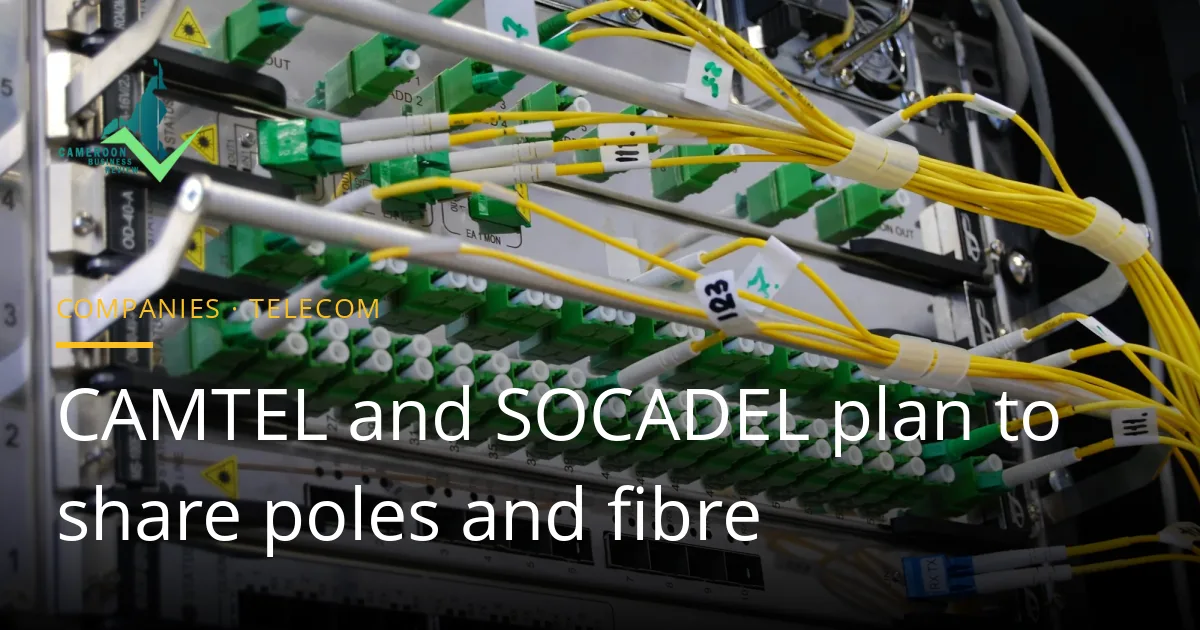
Cameroon's two biggest state-owned network companies want to stop digging the same trenches. CAMTEL, the national telecom operator, and SOCADEL, the public electricity company, signed a memorandum of understanding in Yaoundé on Friday 16 October to explore CAMTEL SOCADEL infrastructure sharing: running fibre-optic cable along power lines and using each other's facilities to lower the cost of expanding both networks.
The deal was reported by Business in Cameroon on 19 October. It is a framework, not a contract. No investment figure, timetable or list of sites has been published yet. But it points at one of the most expensive problems in Cameroon's digital and power build-out: the cost of civil works.
What the CAMTEL SOCADEL infrastructure sharing plan covers
According to Business in Cameroon, each company brings different assets to the table.
CAMTEL, led by general manager Judith Yah Sunday Achidi, offers:
- its national fibre-optic backbone, which Business in Cameroon reported in July at nearly 12,000 km
- domestic and international connectivity capacity
- its experience deploying telecom networks
SOCADEL, led by general manager Oumarou Hamandjoda, offers:
- access to its electricity infrastructure, including utility poles
- rights-of-way along its lines
- facilities that could host fibre installations
The expected uses run both ways. CAMTEL could extend fibre along power corridors and build alternative routes, so that a single cable cut does not take a region offline. SOCADEL could use CAMTEL's network to connect its agencies, operating centres and key facilities, which matters for metering, outage management and billing. The two also plan to coordinate future works so they do not lay duplicate installations, especially in city corridors.
What has to happen before any cable goes up
The memorandum sets out a sequence:
- Feasibility studies covering technical requirements, economics, regulatory compliance, infrastructure security and the protection of each institution's rights.
- A framework agreement setting the scope, conditions and how the work will be done.
- Pilot sites, where implementation would start before any wider roll-out.
That process can take months. The questions to watch are who pays for pole reinforcement, how fees are set between two public companies, and who is responsible when a power crew damages a fibre line or a telecom crew works near live cables.
The companies' financial position
CAMTEL is the stronger of the two on paper. Business in Cameroon reports revenue of more than CFAF 235 billion in 2025, up from CFAF 217 billion in 2024, and net profit of more than CFAF 13 billion. It says the operator has invested more than CFAF 145 billion in infrastructure since 2021.
The network has had quality problems. The Telecommunications Regulatory Board launched an audit of the national fibre network in May 2025, at an estimated cost of CFAF 350 million, after repeated complaints about service disruptions. Extra routes along power lines would give CAMTEL more redundancy.
SOCADEL is younger and more stretched. It was set up as a state-owned company in May 2026 to replace Eneo Cameroon. On 31 August it appointed three local banks to arrange a proposed CFAF 200 billion financing package to refinance debt and meet liquidity needs. Sharing costs with a profitable partner is attractive for a utility in that position. We have tracked its other recent moves, including a CFA52.6 billion fuel tender for 33 thermal plants.
Why it matters for businesses
For companies in Cameroon, two things could change if the plan works.
- Cheaper, wider fibre. Laying cable on existing poles usually costs far less than trenching. That could bring fibre to towns and industrial sites that are currently served only by mobile data. CAMTEL has already signed a deal to bring fibre to public housing with SIC, a sign it wants to reach more end users.
- Better grid management. A utility with reliable data links to its substations and offices can detect faults faster and manage prepaid metering more smoothly, which affects every business that depends on steady power.
Power and telecom companies share poles and corridors in many countries. The test here is execution. An MoU between two state firms is easy to sign. Turning it into a priced, enforceable agreement with clear liability is the hard part.
Would shared poles and fibre make a difference where your business operates? Tell us which towns need it most.