The Port Authority of Douala (PAD) used two diplomatic meetings on 21 October to pitch the next phase of the Douala port expansion. It met the European Union's ambassador and, separately, France's ambassador, and put its deep-water extension towards Manoka Island at the centre of the conversation. According to Business in Cameroon, which reported the meetings on 22 October, no financing agreement or investment commitment came out of either meeting.
That makes this an early-stage story. It is still worth following closely, because the Manoka plan is the most expensive piece of Cameroon's port strategy and the one that decides whether Douala can keep its regional role.
Who met whom
PAD was represented by deputy general manager Charles Michaux Moukoko Njoh, standing in for general manager Cyrus Ngo'o, who was at the fifth Translog Africa Symposium in Burkina Faso.
- European Union: Ambassador Véronika Bošković Pohar discussed infrastructure investment, port security and links with European ports. The EU pointed to two programmes: SCOPE Africa, which supports port security and governance, and Global Gateway, the EU's international infrastructure investment strategy.
- France: Ambassador Sylvain Riquier, with Anne Brouard of the embassy's economic department, discussed financing, technical expertise, digitalisation, training and maritime security. The French delegation toured port facilities and ongoing works. The Manoka extension "received particular attention", Business in Cameroon reported.
The Douala port expansion plan in numbers
PAD's 2020–2050 master plan sets the scale:
- raise annual cargo capacity from about 13 million tonnes to more than 45 million tonnes by 2050;
- upgrade existing facilities and build new terminals;
- build a deep-water extension towards Manoka Island;
- add a new bulk terminal on the right bank of the Wouri, better cargo scanning and tighter security at port gates;
- develop an integrated port, logistics and industrial hub.
Cost estimates come from the World Bank Group's Cameroon Country Private Sector Diagnostic of December 2022: about CFA300 billion to modernise existing Douala facilities and about CFA900 billion for the Manoka deep-water extension. These are not updated project budgets, and construction costs have risen since 2022, so the real figures are likely to differ.
Why depth matters
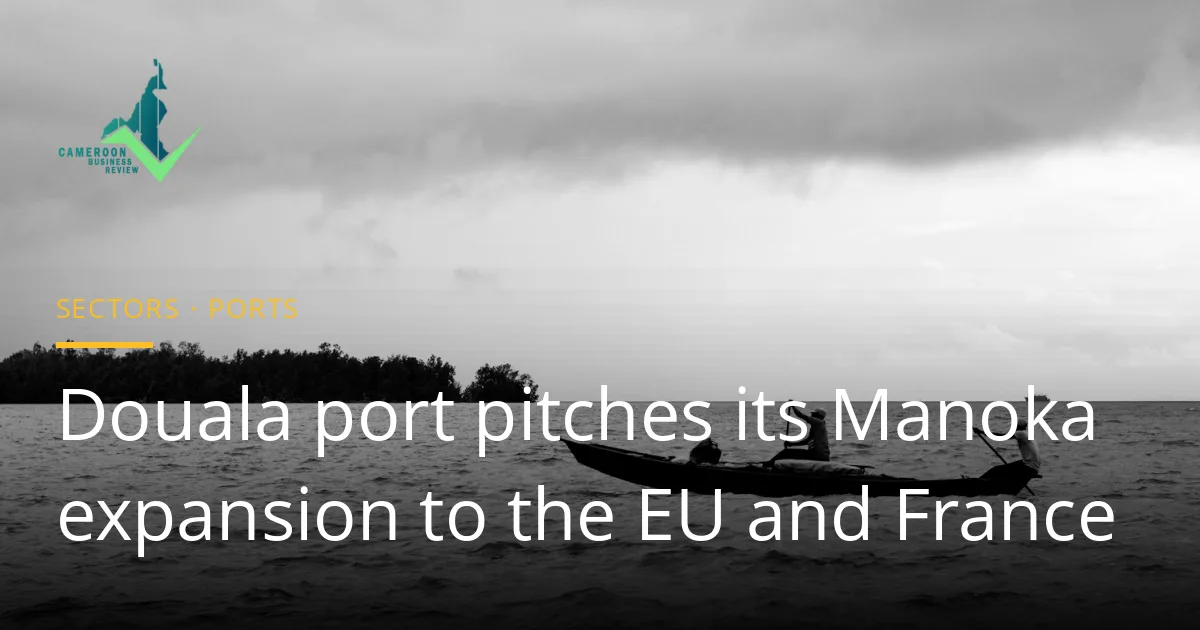
Douala is a river port on the Wouri estuary. Its channel limits the size of ships that can call, and keeping it open requires regular dredging. A deep-water site at Manoka, closer to the open sea, would let larger vessels call without the same draught limits. That is the main commercial argument for the extension.
Why Douala needs the money
Douala is still the main gateway for Cameroon's imports and exports, and for landlocked Chad and the Central African Republic through the Douala–N'Djamena and Douala–Bangui corridors. But it faces competition on several fronts:
- Kribi: Cameroon's own deep-water port in the south already takes larger ships and is drawing container traffic.
- Regional ports: transit customers in Chad and the CAR can be courted by other coastal ports if Douala's costs and delays rise.
- New markets: PAD is trying to win cargo from further afield. We reported this week on its push to attract Burkina Faso transporters to Douala.
A port that cannot take larger ships, or that spends heavily just to keep its channel open, struggles to win that competition on price.
The financing problem
The timing of the pitch is not easy. Cameroon's public finances are tight. Fitch downgraded the country to B- this month, Eurobond yields have hit records, and talks on a new IMF programme have stalled, putting about CFA300 billion of 2027 budget support at risk. In that setting, a CFA900 billion port project is unlikely to be funded from the state budget alone.
That leaves a few realistic routes:
- Concessional loans from development partners, such as the French development agency or European lenders under Global Gateway. Neither was named as a financier in this week's meetings.
- Public-private partnerships, where a terminal operator builds and runs a terminal in exchange for a long concession. This is how many African deep-water terminals have been financed.
- Phased construction, starting with smaller, revenue-generating pieces such as the bulk terminal and scanning upgrades.
What to watch
- Whether the EU lists the Manoka extension or Douala port security work as a Global Gateway project.
- Any feasibility studies, environmental assessments or tender notices for Manoka.
- Updated cost estimates to replace the 2022 World Bank figures.
- Whether PAD moves ahead with the bulk terminal and scanners first, which would be cheaper and quicker.
For now, the Douala port expansion has diplomatic interest but no committed money. The next sign of progress will be a named financier or a published study, not another meeting.
Photo: Edouard Tamba / Unsplash