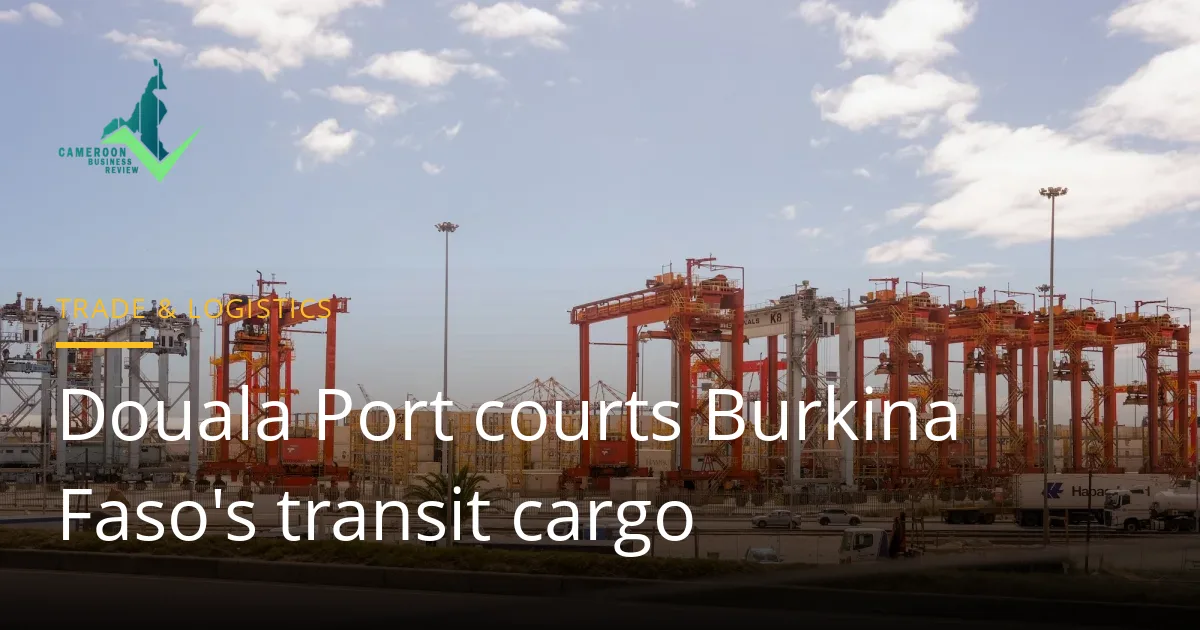
Douala Port wants a share of Burkina Faso's import and export traffic. The Port Authority of Douala (PAD) has opened talks with road transport operators from Burkina Faso to attract transit cargo to Cameroon's main seaport, Business in Cameroon reported on 21 October.
The stated goals are lower transport costs, smoother customs procedures and easier movement of goods between Douala and Ouagadougou. No cargo agreement has been signed yet. What exists so far is a first meeting and a plan for the next round of talks.
Douala Port and Burkina Faso: who met, and where
PAD Director General Cyrus Ngo'o met a delegation of Burkinabe transporters led by their vice-president, Issoufou Maiga. The meeting took place on the sidelines of Translog Africa 2026, the fifth International Transport and Logistics Symposium, held from 20 to 22 October at the Ouaga 2000 Conference Centre in Ouagadougou.
The two sides agreed to bring in the Groupement des Transporteurs Terrestres du Cameroun (GTTC), the Cameroonian road hauliers' association, as an operational go-between in later negotiations. That choice matters. Any corridor between a coastal port and a landlocked country depends on truck operators on both sides agreeing on rates, loads, documents and turnaround times. Putting the two hauliers' groups in direct contact is a practical first step.
The cargo Douala has in mind
According to the report, PAD named specific goods it believes could move through Douala:
- Imports to Burkina Faso: petroleum products, fertilizers, wheat and clinker (the main ingredient in cement).
- Exports from Burkina Faso: cotton, sesame and shea products.
These are bulk, price-sensitive goods. Fertilizer and clinker are heavy and cheap per tonne, so transport cost often decides which port a buyer uses. Cotton, sesame and shea are among Burkina Faso's main agricultural exports, and their buyers care about reliable shipping schedules as much as price.
A crowded field of rival ports
Douala is not starting from an empty market. Burkina Faso already ships through several coastal ports in West Africa. The Business in Cameroon report names Lomé in Togo, Tema in Ghana, Abidjan in Côte d'Ivoire and Cotonou in Benin.
Those ports have long-standing transit arrangements, trucking networks and customs links with Burkina Faso. To win business from them, Douala will need to offer something concrete: lower total cost from ship to warehouse, faster clearance, or more reliable delivery. Promises alone will not move a fertilizer importer who already has a working supply chain.
What Douala already does well
Douala has experience as a transit port. It already handles cargo for two landlocked neighbours, Chad and the Central African Republic. That gives PAD procedures, staff and relationships it can point to when it pitches to Burkinabe operators.
The push also fits a wider effort by Cameroon to earn more from trade that passes through the country rather than ending in it. Earlier this week we covered another plan aimed at cutting import bills, a proposed CFA8.8 billion organic fertilizer plant. Fertilizer appears on both lists, which shows how central that product is to regional trade flows.
What PAD has not said
The announcement leaves several important questions open. PAD did not disclose:
- how much cargo it hopes to attract, in tonnes or containers;
- how much it expects shippers to save compared with current routes;
- a timetable for the negotiations or a target date for a first shipment;
- which overland route goods would take between Douala and Ouagadougou.
The route question is probably the hardest. Ouagadougou is far from Douala, and any road link crosses other countries, each with its own border posts, fees and security conditions. The cost and reliability of that journey will decide whether the corridor works, more than anything that happens at the quay.
Why it matters for Cameroonian business
For Cameroon, new transit traffic would mean more volume through the port, more work for trucking firms and customs agents, and more revenue for PAD. Transport operators in the GTTC could gain a new long-haul market if the talks lead to regular flows.
For now, the right reading is cautious. A meeting at a logistics conference is the start of a sales process, not a deal. The next signals to watch are a formal agreement between PAD and the Burkinabe hauliers, any pricing offer for transit cargo, and the first trial shipments. If those follow in the coming months, Douala's pitch will have moved from intention to business.
Source: Business in Cameroon, 21 October 2026.