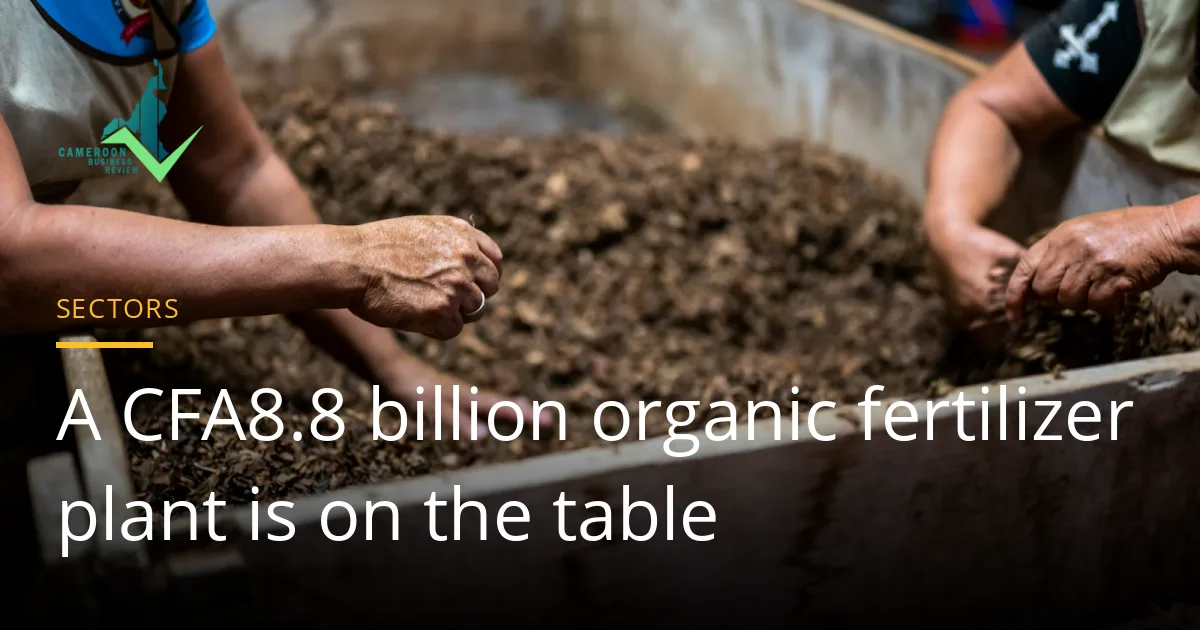
A Cameroonian agricultural inputs company and an Indonesian fertilizer maker are considering building an organic fertilizer plant in Cameroon, in a project valued at about $15 million, or roughly CFA8.8 billion. The figure was made public on 19 October 2026 by Indonesia's Ministry of Foreign Affairs, after the Trade Expo Indonesia 2026 fair, according to reporting by Investir au Cameroun and Business in Cameroon.
The two companies are TMG International Investment Group PLC, based in Cameroon, and PT Turrima Agro Mass, from Indonesia. They signed a memorandum of understanding on 16 October covering the transfer of agricultural technology and the development of local production capacity.
The amount is a potential investment. It is not committed funding, and several basic details of the project have not been released.
What the organic fertilizer plant would include
According to the Indonesian statement, as reported by Indonesian outlets Media Indonesia, Shangbao Indonesia and Disway on 18 October, the factory would sit inside a 25-hectare integrated agricultural complex. The plans described so far include:
- laboratories;
- storage and processing areas for raw materials;
- land for crops and livestock.
The idea is to turn organic matter from farming and animal rearing into fertilizer on site. The ministry did not say how the $15 million would be split between industrial equipment and the other facilities.
What is still unknown
Business in Cameroon notes that no financing plan, construction contract, location, annual production capacity or start date has been disclosed. Nor has it been said how the partners would secure the 25 hectares. Until those details appear, the project is best read as an intention backed by a signed memorandum, not a funded build.
A supplier relationship that is nine years old
The partnership is not new. According to the Indonesian Embassy in Cameroon, TMG's president, Tebid Harmony Fongang, has imported Turrima's organic fertilizers for nine years.
Two of those products already appear on the official list kept by Cameroon's Ministry of Agriculture and Rural Development (Minader). They are registered as entry 152, Rhyzobium Polyvalent TMG, and entry 153, Bio Stimulant A-C-G 7-5-6 TMG, both formulated by Turrima Agromass.
TMG also has a record in public procurement. On 17 September 2024, the PULCCA programme awarded the company a framework agreement worth CFA999.9 million, including taxes, to supply agricultural inputs and equipment in the Adamawa region. Investir au Cameroun points out that no link has been established between that contract and the new plant.
Why local production matters: the shipping and import bill
Turrima's founder and chief executive, Mulyono, said shipping fertilizer by sea from Indonesia to Cameroon takes 50 to 60 days. Making the product locally would cut freight costs and reduce exposure to international supply chains, he said, while adding that technical studies are still needed on the use of local raw materials.
The wider numbers explain the interest. Cameroon buys most of its fertilizer abroad:
- Imports reached CFA44.4 billion in the first half of 2025, up from CFA40.2 billion a year earlier, an increase of about 10.4%, according to Business in Cameroon, citing the government's economic outlook report.
- In 2023, the country imported 228,326 tonnes of fertilizer, 76.2% more than in 2022, for CFA70.9 billion, according to National Institute of Statistics (INS) data reported by Business in Cameroon.
- Between 2021 and 2023, fertilizer imports cost CFA173.9 billion in total, by the same source.
The INS linked part of the 2023 price spike to the war in Ukraine and to the lack of domestic production. Fertilizer prices matter well beyond the input trade: they feed into the cost of producing cocoa, coffee, cotton and food crops at a time when export earnings are under pressure. We looked at that pressure recently in our analysis of cocoa and banana exports.
Where this fits among Cameroon's fertilizer projects
Cameroon has tried for years to make more of its own fertilizer, with mixed results.
The first chemical fertilizer plant to start running was Hydrochem Cameroun's unit in Bonaberi, Douala, inaugurated on 7 May 2025 by Agriculture Minister Gabriel Mbaïrobé. Hydrochem, a subsidiary of the Noutchogouin Jean Samuel (NJS) group, said the plant can produce 120,000 tonnes a year, expandable to 150,000 tonnes. It works mainly by importing raw materials in bulk and blending fertilizers locally to customers' needs. At the launch, the minister said annual imports were estimated at about 300,000 tonnes and that he expected the plant to halve that figure. NJS had already bought Yara's local fertilizer business in December 2023.
Earlier efforts stalled. A project with Germany's Ferrostaal was stuck for more than 12 years before the government announced three new plants in 2023, according to Business in Cameroon.
Separately, the Ministry of Mines, Industry and Technological Development has called for consultants to carry out a front-end engineering design study for a much larger chemical fertilizer plant, estimated at CFA500 billion and planned as a public-private partnership. That project is listed in the 2026-2028 medium-term budget programming document.
How the TMG-Turrima project differs
The TMG-Turrima plan is smaller and of a different kind. It targets organic fertilizers made from farm and livestock waste, not chemical blends from imported raw materials. At CFA8.8 billion, it is a fraction of the state-backed chemical plant's estimated cost.
What to watch next
For farmers, input dealers and investors, the useful signals will be concrete ones:
- a named site and a deal for the 25 hectares;
- a stated annual output in tonnes, which would show how much of the import bill the plant could replace;
- a financing structure and a construction contractor;
- product registration with Minader for any new locally made fertilizers.
Until then, the CFA8.8 billion figure remains a statement of intent from two companies with a long trading history, published by a foreign ministry after a trade fair. It is a credible starting point, given that TMG already sells Turrima products registered in Cameroon, but it is not yet a factory.