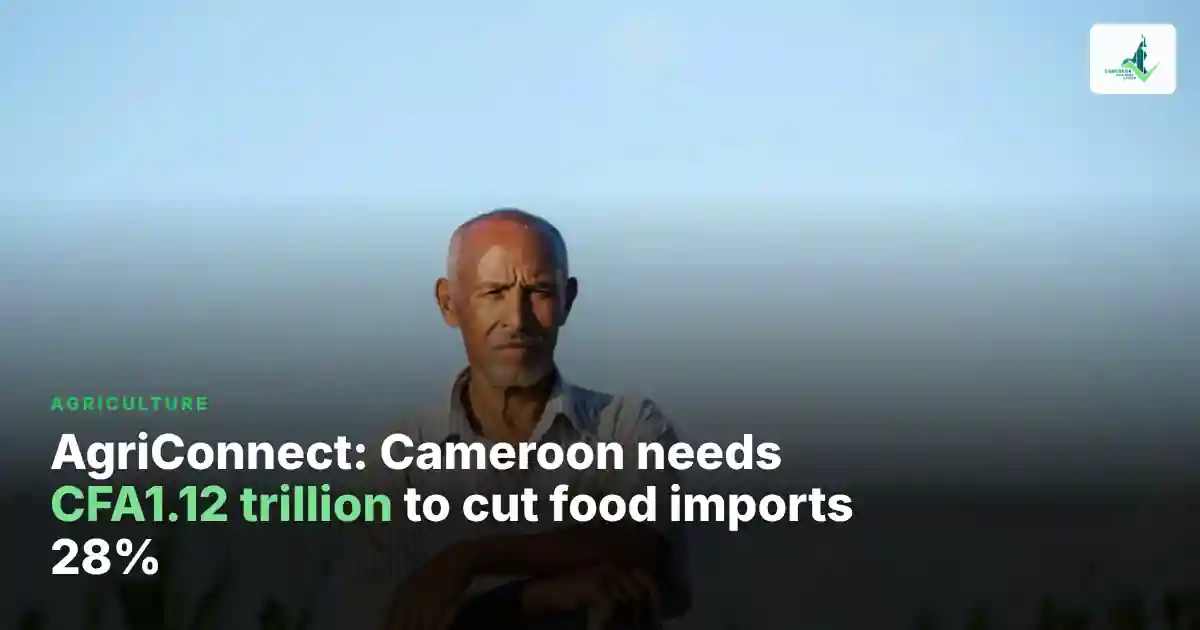
Cameroon has signed a new plan to grow more of its own food, and it comes with a large price tag. The Cameroon AgriConnect pact, launched in Yaoundé on 21 October 2026 with World Bank Group support, sets out 24 interventions for 2026 to 2030 that would need about $1.87 billion, or nearly CFA1.12 trillion, in investment. Its headline goal is to cut the country's food import bill by 28% by the end of the decade.
The figures were reported by Business in Cameroon's Ludovic Amara, citing the International Fund for Agricultural Development (IFAD). For a country that still imports large volumes of rice, fish, milk and vegetable oil, the targets are ambitious. The question for investors and farmers is where the money comes from.
What the Cameroon AgriConnect pact covers
AgriConnect focuses on eight value chains:
- corn
- rice
- cassava
- palm oil
- cocoa
- soybeans
- milk
- fisheries and aquaculture
The interventions fall into four broad groups: better production conditions (seeds, equipment, irrigation and rural infrastructure), administrative and regulatory reforms, wider access to finance for farmers and agribusinesses, and investment in storage, processing, cold chains and digital tools.
The targets for 2030
According to the IFAD figures, the pact aims to reduce the food import bill from about $1.6 billion to $1.15 billion. To get there, it sets production goals for each chain:
- Corn: 6 million tonnes a year.
- Palm oil: 800,000 tonnes a year.
- Rice: domestic output covering 55% of national demand.
- Milk: local production meeting 60% of consumption.
- Fisheries and aquaculture: 450,530 tonnes.
Cameroun Actuel reported on 21 October that the plan also aims to issue 500,000 land titles. That target does not appear in the World Bank or IFAD statements cited by Business in Cameroon, and its scope is not clear, so it should be treated with caution until officials publish details.
Who runs it
A steering committee co-chaired by the ministries of agriculture and livestock will oversee the pact. The Ministry of the Economy, private sector representatives and development partners also sit on it. A consolidation workshop in Yaoundé on 15 September prepared the signing.
Agriculture Minister Gabriel Mbaïrobé presented AgriConnect as a way to coordinate existing policies and programmes rather than replace them, according to Business in Cameroon's account of his remarks. The pact sits under the National Development Strategy 2020–2030 (SND30) and the Integrated Agropastoral and Fisheries Import Substitution Plan, known by its French acronym PIISAH.
The financing gap
The most important number is the one that has not been published. Business in Cameroon notes there is no breakdown yet of how much of the CFA1.12 trillion is already committed by the state and donors, and how much still has to be raised. No job creation estimate has been released either.
That matters because public money is tight. Cameroon's 2027 budget preparations have already run into trouble with the IMF over the size of the deficit, as we reported in our analysis of the 2027 budget deficit target. Execution of the investment budget has also been slow this year. A plan of this size will depend heavily on World Bank and IFAD lending, and on private agribusiness putting in capital.
What it means for business
For companies, the pact signals where the government wants activity to grow. Three areas stand out.
- Processing and storage. Cold chains, warehouses and processing plants are named priorities. Investors in rice milling, dairy collection, fish handling and palm oil refining could find state and donor support easier to access.
- Inputs. Higher corn and rice output needs seed, fertiliser and equipment. Plans such as the CFA8.8 billion organic fertiliser plant announced this week fit the same import-substitution logic.
- Finance. Better access to credit for farmers is one of the four pillars. Banks and microfinance lenders may see new guarantee schemes or refinancing lines if donors fund them.
Import substitution has been a stated goal in Cameroon for years, and earlier programmes did not close the gap on rice or fish. The difference this time, officials say, is coordination: one framework that ties existing projects to measurable targets. Whether that works will show in the yearly import figures, which are the clearest test of the 28% goal.
Local production opportunities already exist at a smaller scale, as our look at Cameroon's pepper imports and youth agriculture showed. AgriConnect aims to repeat that logic across eight much larger markets.
What to watch
The next steps to follow are the publication of the financing plan, the first steering committee decisions, and any new World Bank or IFAD loans tied to the pact. Without a clear split between committed and missing funds, it is hard to judge how much of the CFA1.12 trillion will actually reach farms and factories before 2030.