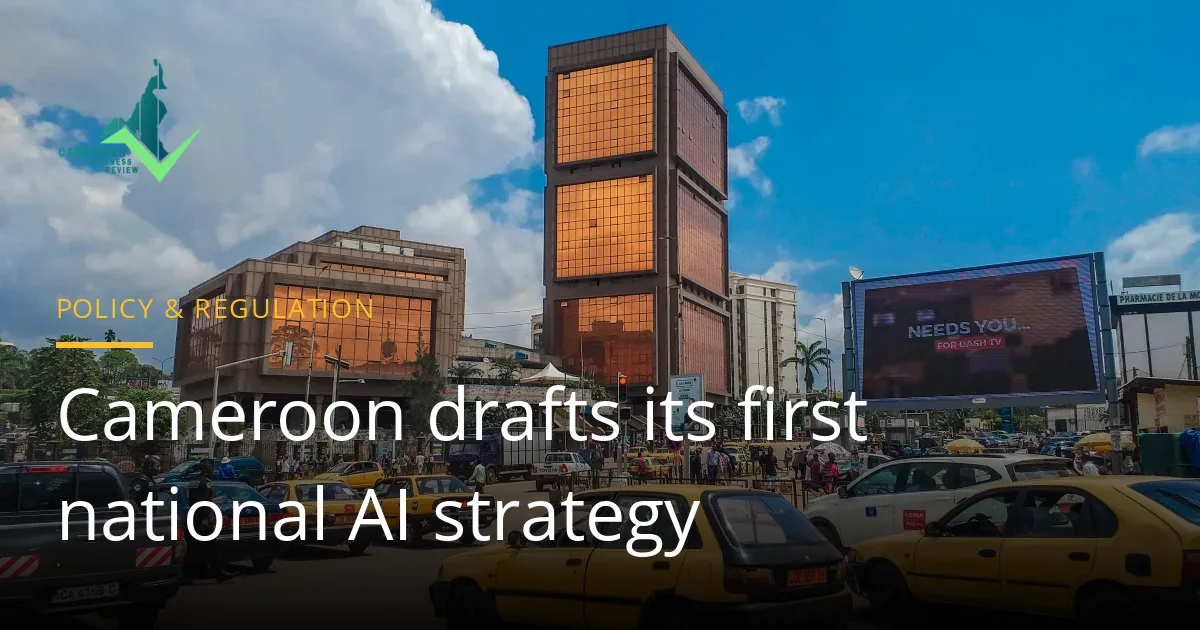
The Cameroon AI strategy is no longer just a talking point. Minister of Posts and Telecommunications Minette Libom Li Likeng told an international audience in Seoul last week that the government is finalising a national strategy for artificial intelligence and, alongside it, a legal framework to regulate the technology.
She made the announcement at the Global AI and Digital Summit, held from 19 to 22 October 2026 in the South Korean capital, according to Business in Cameroon, which cited coverage in Cameroon Tribune. The summit was organised by the World Bank Group together with South Korea's Ministry of Economy and Finance and its Ministry of Science and ICT.
For companies operating in Cameroon, the announcement matters for two reasons. It signals which parts of the digital economy the state intends to prioritise, and it confirms that rules on how businesses may use AI are on the way.
What the Cameroon AI strategy covers
According to the minister's presentation, the draft is framed as a national strategy for developing Cameroon's digital economy and was shaped by national consultations on AI. Its stated goals are to support job creation, raise productivity and improve public services.
The plan is organised around five areas:
- Digital infrastructure: the networks, data centres and connectivity that AI services depend on.
- Data governance: how data is collected, stored, shared and protected.
- Workforce development: training people to build, use and supervise AI systems.
- Research and innovation: support for local research and new products.
- Responsible use of AI: rules and principles for how the technology is deployed.
Those headings are broad, and the minister's remarks as reported did not go into detail on how each one will be funded or measured.
A law to regulate AI is also in preparation
The second part of the announcement may prove more consequential for business. Libom Li Likeng said the government is developing a national framework to regulate AI as the technology spreads, and stressed the need for appropriate rules on adoption.
No draft text has been published. That leaves open the questions that companies will care about most: which uses of AI would be restricted, whether there will be registration or audit requirements, which regulator would enforce the rules, and how a new framework would sit alongside existing telecoms and data rules.
Banks, telecom operators, insurers and firms that handle large volumes of customer data are the most likely to be affected first, since they are the heaviest users of automated decision systems in most markets. Until the text is out, any such assessment remains a guess.
What is still missing
The reporting on the announcement leaves several gaps, and they are worth stating plainly:
- No budget. No investment figure or funding source for the strategy has been made public.
- No timeline. There is no stated completion date or launch date for either the strategy or the regulatory framework.
- No lead institution beyond the ministry. The reporting does not name an agency that will carry out the plan.
These details tend to decide whether a national strategy changes anything on the ground. A plan with named funding, deadlines and an accountable body is easier for investors and partners to take seriously than a list of priorities.
The regional angle: the Cotonou Declaration
Cameroon also took part in discussions under the Cotonou Declaration, which aims to create a unified African digital market by 2030. Its shared objectives include connectivity, digital skills and AI. The Ministry of Posts and Telecommunications said Cameroon's participation reflects its commitment to inclusive digital transformation and regional cooperation.
For Cameroonian tech firms, regional alignment could eventually mean that rules adopted at home look similar to those in neighbouring markets, which lowers the cost of expanding across borders. That depends on how closely the national text follows any common framework.
Why infrastructure comes first
Infrastructure sits at the top of the strategy's list for a practical reason: AI services need reliable power and fast, affordable connectivity. Cameroon's operators are already working on the cost side. Earlier this month we reported on the CAMTEL and SOCADEL plan to run fibre on power poles, a deal meant to cut the cost of extending networks.
Projects of that kind will shape how far any AI plan can reach outside Douala and Yaoundé. A strategy that names infrastructure as a priority will be judged partly on whether it speeds up that sort of investment.
What businesses should watch next
Three things will show how serious the plan is:
- Publication of the draft strategy, ideally with a budget and a schedule.
- The first text of the AI regulatory framework, and whether the private sector is consulted on it.
- Funding partners. The World Bank's role in hosting the Seoul summit suggests development lenders are interested in digital projects, but no financing for Cameroon's plan has been announced.
Until those details arrive, the announcement is a statement of direction rather than a programme. It is still a useful one: it tells companies that AI rules are coming, and that the time to prepare internal policies on data and automated decisions is now rather than after a law is passed.
Sources: Business in Cameroon (26 October 2026), citing Cameroon Tribune; World Bank Global AI and Digital Summit 2026 event page.