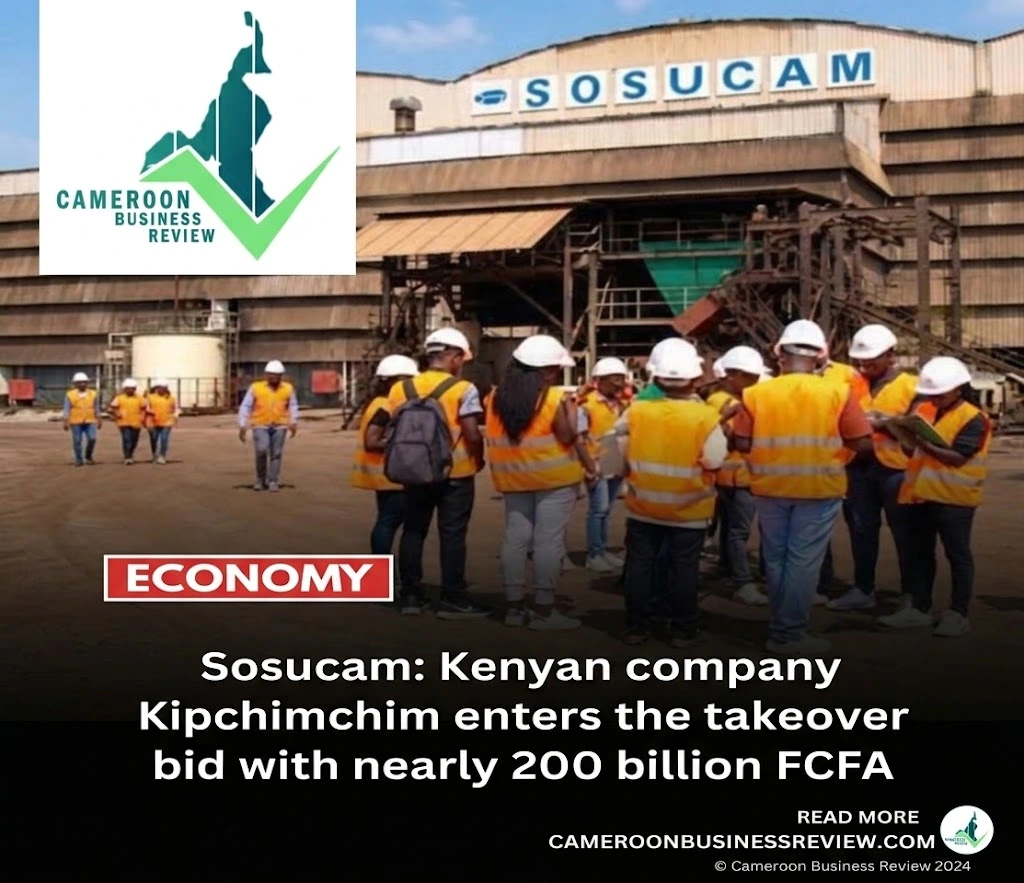
The proposed sale of Société Sucrière du Cameroun (Sosucam) has entered a new phase, with the reported emergence of a Kenyan investor adding another dimension to a transaction already under close scrutiny from the Cameroonian government.
Kenya’s Kipchimchim Group has reportedly positioned itself as a potential buyer of Somdia’s 82% controlling stake in Sosucam, with an offer estimated at €304 million, or roughly CFAF 200 billion. According to reporting by EcoMatin, the proposal is supported by Afriland First Bank and comes after a mission from the strategic committee established by the Prime Minister to assess the Kenyan group’s sugar operations. (EcoMatin)
The development comes only weeks after Somdia, the agro-industrial subsidiary of France’s Castel Group, announced an agreement to transfer its 82% stake to a consortium of five Cameroonian investors. That transaction, announced on August 13, included a proposed €210 million, or approximately CFAF 137.7 billion, multi-year investment programme to modernise Sosucam. (Cameroon Business Today)
The government subsequently suspended the transfer process while a strategic committee examines its implications. The result is an increasingly complex ownership question around one of Cameroon’s most important agro-industrial companies.
A Sale Placed Under Government Review
The current situation dates back to early August, when the Prime Minister’s Office instructed Somdia to suspend, with immediate effect, steps relating to the proposed sale of its Sosucam shares.
A letter dated August 10 from the Director of Cabinet of the Prime Minister requested that Somdia refrain from further action while a Strategic Steering Committee examined the implications of the proposed transaction. The government cited the strategic importance of Sosucam, including economic, social and food-security considerations. (Cameroun Online)
Three days later, on August 13, Somdia announced that it had reached an agreement with a consortium of five Cameroonian investors for the transfer of its 82% stake.
The consortium comprises Joseph Pagop Noupoué, Henriette Noutchougouin, William Nkontchou, Igor Djoukwé and Marcel Tchagongom. The agreement remains subject to conditions precedent, meaning the announcement did not in itself represent the final completion of the transaction. (EcoMatin)
The proposed investors also presented a long-term industrial investment programme worth CFAF 137.7 billion. The stated objectives include improving operational performance, modernising production infrastructure, preserving employment and making greater use of sugar-industry by-products. (panoramapapers.com)
The government formally maintained its intervention, leaving the proposed transfer under review.
Kipchimchim Changes the Equation
The emergence of Kipchimchim Group introduces a different potential route for Sosucam.
According to EcoMatin, the Kenyan group has submitted a financial proposal estimated at €304 million, equivalent to about CFAF 200 billion, with financing support from Afriland First Bank. A mission from the Prime Minister’s Strategic Committee reportedly travelled to Kenya in September to visit Kipchimchim’s sugar facilities, with the visit concluding on September 19. (EcoMatin)
This does not mean that Kipchimchim has acquired Sosucam or that its proposal has been accepted. Rather, its reported offer gives the government another option to examine while the strategic review is underway.
The distinction is important because the Sosucam transaction is no longer simply a question of whether Somdia can transfer its shares to the previously announced Cameroonian consortium. The government is now examining the broader strategic implications of who should ultimately control the company and under what financial and industrial conditions.
Kipchimchim's interest also introduces a regional dimension. A Kenyan investor with experience in the East African sugar industry would bring a different operational model and access to regional agricultural expertise. The proposed CFAF 200 billion financing envelope is also significant when compared with the CFAF 137.7 billion investment programme announced by the Cameroonian consortium.
However, the two figures should not be treated as directly equivalent. The CFAF 200 billion figure reported for Kipchimchim concerns its proposed acquisition offer, while the CFAF 137.7 billion announced by the Cameroonian consortium refers to a multi-year investment programme. They represent different components of the transaction and should therefore be assessed separately.
Why Sosucam Matters Beyond the Shareholding
The intense interest in Sosucam is closely connected to its role in Cameroon’s agricultural and industrial economy.
Sosucam operates two major agro-industrial complexes at Mbandjock and Nkoteng in the Centre Region, supported by an agricultural estate covering approximately 27,600 hectares. The company is also a major contributor to national sugar supply and employs thousands of people across its agricultural and industrial activities. (ECONOMIE DU CAMEROUN)
The company’s importance extends beyond the production of table sugar.
Sugar is an input for several sectors of the economy, including beverages, food processing and pharmaceuticals. Consequently, disruptions to domestic sugar production can affect manufacturers and increase pressure on imports.
Cameroon consumes close to 300,000 tonnes of sugar annually, while Sosucam supplies a substantial portion of the domestic market. Some reporting estimates the company at roughly one-third of national consumption. (ECONOMIE DU CAMEROUN)
This helps explain why the government has treated the proposed change in ownership as more than a conventional private-sector transaction.
The company also carries a substantial employment and local-economic footprint. Reports put the number of direct and indirect jobs linked to Sosucam at several thousand, while the company's operations generate significant economic activity around its production sites. (Cameroun Online)
The Industrial Challenge Waiting for Any Buyer
Ownership is only one part of the Sosucam equation.
The eventual investor will inherit an operation requiring substantial capital, operational restructuring and industrial modernisation. Reporting following the August agreement highlighted the need to restore production capacity, strengthen agricultural operations and secure the next sugar campaign. (L'Economie)
The financial condition of the business has also become a central issue in the debate surrounding Somdia’s exit. Recent reporting has pointed to significant accumulated losses and growing financing requirements, making the company’s future dependent not simply on the identity of its shareholder but on the shareholder’s ability to deploy capital and execute a credible recovery programme. (ECONOMIE DU CAMEROUN)
For any prospective buyer, the challenge therefore extends across several fronts:
Industrial modernisation: ageing production equipment and infrastructure require substantial investment.
Agricultural productivity: plantation renewal and improved yields will be important for increasing cane availability.
Financial restructuring: the company needs a sustainable balance sheet capable of supporting future investment.
Employment: thousands of workers and surrounding communities depend on Sosucam's continued operations.
Domestic supply: maintaining reliable sugar production remains important for manufacturers and consumers.
Import dependence: improving local production could reduce pressure created by reliance on external supplies.
The CFAF 137.7 billion investment programme announced alongside the Cameroonian consortium's agreement and the reported CFAF 200 billion Kipchimchim proposal therefore need to be evaluated not only by headline value, but by how much capital would actually reach plantations, factories, logistics and working capital.
Domestic Capital Versus Regional Industrial Expertise
The competing approaches raise a broader question about the future ownership of strategic agro-industrial assets in Cameroon.
The proposed Cameroonian consortium would place Sosucam under the control of local private investors while committing significant capital to its modernisation. Its composition brings together business, finance, legal and industrial expertise. The arrangement therefore represents a domestic-capital approach to retaining ownership of a major agricultural enterprise within Cameroon. (EcoMatin)
Kipchimchim, by contrast, represents a regional investor approach. Its reported proposal would bring Kenyan ownership and experience into a Cameroonian sugar operation, with financing support from a major Cameroonian banking institution. (EcoMatin)
Neither approach removes the central challenge facing Sosucam: the company needs sustained investment and operational improvements.
The government's strategic review therefore has implications beyond the immediate share transfer. It will need to consider the proposed buyer's financial capacity, investment commitments, operational expertise, employment implications, agricultural development plans and ability to maintain stable domestic sugar supplies.
What Happens Next?
The Strategic Steering Committee established by the Prime Minister has been given a six-month period to examine the transaction and its implications. The committee's work places the government at the centre of a process that began as a corporate divestment but has evolved into a broader discussion about industrial policy and strategic assets. (Cameroun Online)
The emergence of Kipchimchim means that the committee now has another proposal to consider alongside the agreement already reached between Somdia and the Cameroonian consortium.
For Somdia, the process also represents the culmination of its planned withdrawal from Sosucam. For potential buyers, meanwhile, the attraction is clear: Sosucam occupies a significant position in one of Central Africa's important consumer markets, with established plantations, processing facilities, distribution networks and an existing workforce.
But the transaction's value will ultimately depend on what happens after ownership changes.
The successful restructuring of Sosucam will require more than a new shareholder. It will require capital discipline, agricultural investment, modern equipment, reliable energy and logistics, stronger productivity and a clear strategy for meeting domestic demand.
Final Thoughts
The Sosucam transaction has moved beyond a straightforward sale of an 82% stake. The announced Cameroonian consortium, the government's intervention and the reported €304 million proposal from Kenya's Kipchimchim Group have transformed the process into a significant test of how Cameroon manages strategic private-sector assets.
The central question now is not simply who can acquire Sosucam, but which ownership and financing structure can deliver the investment required to restore the company while supporting domestic sugar supply, employment and long-term industrial development.
With the government's strategic review still underway, the final direction of Sosucam remains open. What is increasingly clear, however, is that the next phase of the company will be shaped as much by the quality of the investment and restructuring plan as by the name of the eventual shareholder.