
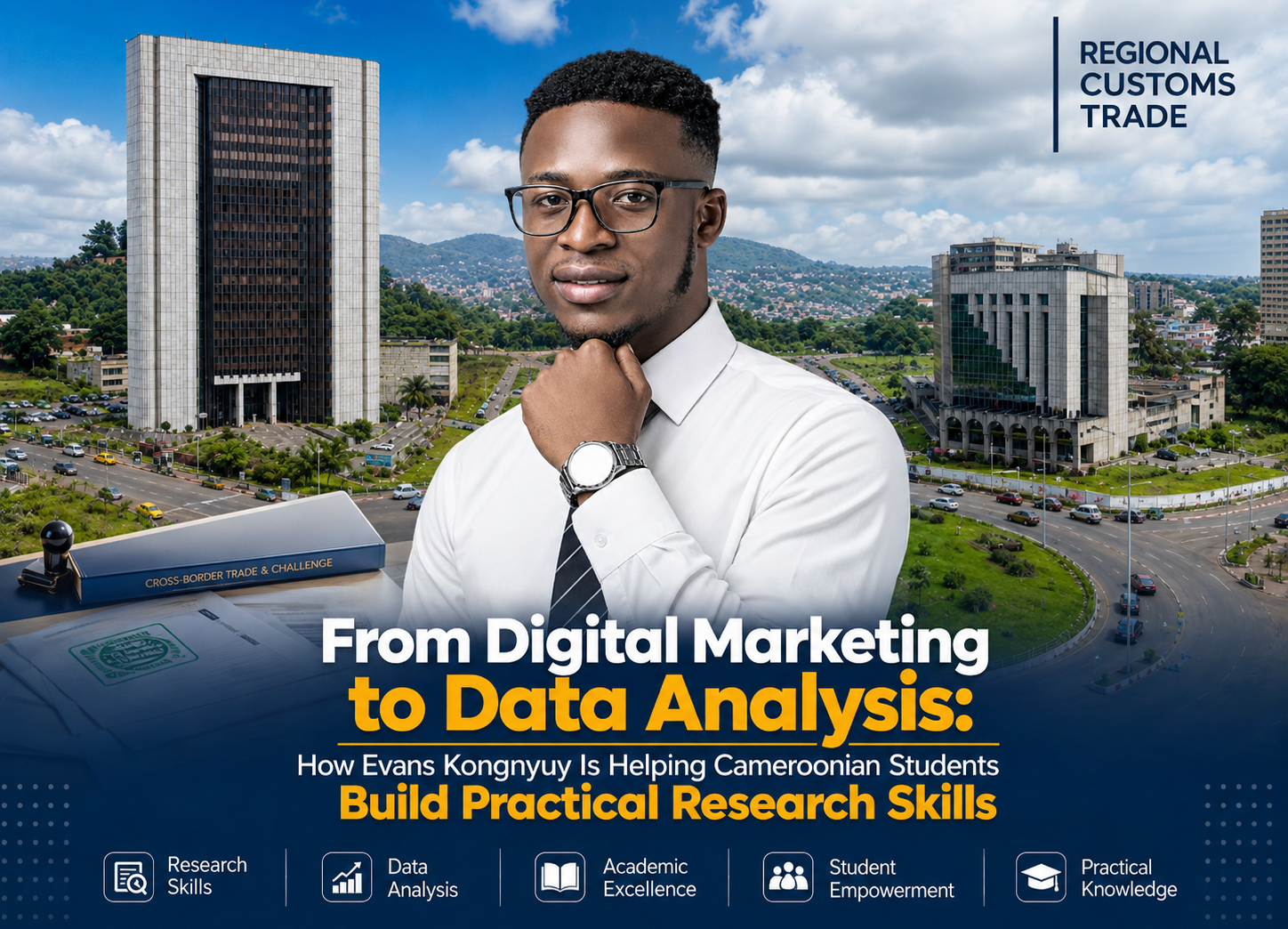
For many university students, the final stages of a research project can be where an academic exercise becomes a practical challenge.
Collecting data is one thing. Knowing what to do with that data is another.
Questions around questionnaire design, data cleaning, descriptive statistics, inferential analysis, interpretation of results and academic writing can quickly become difficult for students working on undergraduate and postgraduate research projects.
In Bamenda and elsewhere in Cameroon, digital marketing professional and trainer Evans Kongnyuy has increasingly found himself working at this intersection between research, technology and practical skills.
Since 2023, Kongnyuy has been conducting data-analysis training for students and young professionals, covering statistical analysis, research methods, academic writing and the use of digital tools to make research workflows more efficient.
According to figures provided by Kongnyuy, he has conducted five cohorts of data-analysis training and trained more than 50 students directly. He also estimates that he has contributed to the research work of more than 100 students through a combination of data analysis, academic rewriting, research mentorship and project guidance.
From Digital Marketing to Research and Data Analysis
Kongnyuy's professional background is primarily rooted in digital marketing and brand strategy.
His professional profile identifies him with experience spanning digital marketing, market research, public relations, social media marketing and search engine optimization.
At first glance, digital marketing and statistical research might appear to be separate professional fields.
In practice, however, the two increasingly overlap.
Digital marketing relies heavily on data. Campaign performance, audience behaviour, customer acquisition, conversion rates and market research all require professionals who can interpret information rather than simply collect it.
For Kongnyuy, that connection has become part of his training work with students.
Five Training Cohorts Since 2023
Since beginning structured data-analysis training in 2023, Kongnyuy says he has completed five cohorts involving more than 50 students.
The training has focused on practical research and statistical analysis rather than treating statistical software as a substitute for understanding research methodology.
Students are introduced to areas including:
Descriptive statistics
Inferential statistics
Quantitative data analysis
Qualitative data analysis
Data cleaning and preparation
Interpretation of statistical results
Research methodology
Academic project writing and rewriting
Statistical software
Artificial intelligence in research workflows
The tools used in the training include SPSS, Microsoft Excel and R, alongside newer AI-assisted approaches to research and analysis.
The emphasis is not simply on learning how to operate software.
A student may learn how to generate descriptive statistics in SPSS, for example, but the process does not end when the output appears on the screen.
The student still needs to understand what the numbers indicate, how they relate to the research questions and how they should be presented in an academic report.
Teaching Students to Understand the Numbers
One recurring challenge in student research is that knowing how to produce a statistical table does not necessarily mean understanding what the table means.
A software package can generate means, frequencies, correlations, regression outputs and significance tests.
The harder question is often what those results actually mean in the context of the research question.
Kongnyuy's training therefore places emphasis on moving from output to interpretation.
The distinction is important because statistical software can make analysis appear easier than it actually is.
A researcher still has to decide whether a particular analytical method is appropriate, whether the data supports the conclusion and how the findings should be communicated.
Introducing AI Into the Research Process
Another part of Kongnyuy's training has emerged from the rapid adoption of artificial intelligence.
Rather than presenting AI as a replacement for researchers, he teaches students how it can be used to accelerate parts of the research process.
AI can assist with tasks such as organizing information, explaining technical concepts, helping structure ideas, supporting repetitive tasks and improving parts of a research workflow.
There is, however, an important distinction between using AI to assist research and allowing AI to replace the researcher's judgement.
A researcher still needs to understand the research question, evaluate sources, select appropriate methods, interpret findings and take responsibility for the final work.
That distinction is particularly important in academic research, where methodological errors can affect the credibility of an entire study.
Beyond Data Analysis
Kongnyuy's work with students has also extended beyond statistical analysis.
He says he has supported more than 100 students through different stages of undergraduate and master's research projects.
The support has included data analysis, academic rewriting, research mentorship, project guidance, methodology discussions and assistance with interpreting research findings.
The distinction between academic support and doing a student's work for them is important.
The purpose of mentorship is to help students understand their own research and improve the quality of their work while maintaining the student's responsibility for the project.
A Cross-Campus Student Network
The students Kongnyuy has worked with have come from several institutions in Cameroon.
These include students associated with the University of Bamenda, University of Buea, Catholic University Institute of Buea, Yaoundé International Business School (YIBS) and other professional institutions.
The geographical spread places his training work within a wider student and professional network rather than a single university environment.
For a young professional based in Bamenda, that network also illustrates how digital tools have made it possible for skills-based training to reach students beyond one physical campus.
Where Data Analysis Meets Business
Kongnyuy's work does not stop at academic research.
He also trains students in marketing and digital marketing, particularly around the practical application of digital tools to business.
This creates an interesting overlap between his research training and professional work.
A student learning how to analyse survey data may later use similar analytical thinking in market research.
A student learning how to interpret customer data can apply that thinking to digital marketing campaigns.
Someone learning how to use AI to accelerate a research workflow can potentially transfer those skills into other knowledge-intensive professional environments.
His Earlier Experience in Digital Marketing
Kongnyuy's interest in practical digital skills predates his data-analysis training.
In 2023, he worked for three months as a volunteer digital marketer, collaborating with digital marketing officer Simplice Sikadi.
During that period, Kongnyuy says the team used social media and telemarketing as part of a student-acquisition campaign that contributed to the enrolment of more than 100 students.
The students acquired through the campaign included undergraduate and postgraduate students as well as learners interested in professional and international programmes such as ACCA and CIA.
The figures are based on Kongnyuy's account of the campaign and would ideally be supported by institutional records if used as a formal case study.
Nevertheless, the experience illustrates the practical connection between marketing and data.
Campaigns generate information. Marketers need to understand that information to decide which audiences to target, which messages to improve and where resources should be allocated.
Why Practical Data Skills Matter
The growing importance of data skills is not limited to universities.
Businesses, NGOs, researchers and public institutions increasingly work with information that must be interpreted before it can support a decision.
That creates demand for people who can move between raw information and useful insight.
In academic settings, this means understanding how to analyse and communicate research findings.
In business, it can mean understanding customers, measuring campaigns or evaluating market opportunities.
The underlying skill is similar: knowing how to ask the right question, work with appropriate evidence and interpret the result responsibly.
Building Skills Beyond the Classroom
What makes Kongnyuy's training approach notable is its combination of several areas that are often taught separately.
Students can encounter statistical analysis, research writing, digital tools, artificial intelligence and marketing within the same learning environment.
That combination reflects a broader change in the skills required by students and young professionals.
Being able to collect information is no longer enough.
Being able to analyse it is increasingly important.
And being able to communicate what the analysis means may be just as important as producing the analysis itself.
From Bamenda to a Wider Professional Audience
Kongnyuy's work also illustrates a wider story about professional development in Cameroon's digital economy.
Professionals are increasingly combining academic knowledge with practical digital skills, while students are looking for training that connects university assignments with the tools they may eventually use in the workplace.
For someone whose professional background began in digital marketing, the move into data-analysis training represents less of a departure than it might initially appear.
Marketing, research and business strategy all depend on the ability to understand information and turn it into decisions.
What Comes Next
As artificial intelligence continues to change how research and business analysis are conducted, the challenge for trainers will be to ensure that technology improves analytical ability rather than replacing it.
For students, this means learning both the tools and the reasoning behind them.
For professionals, it means becoming comfortable working with data while maintaining the judgement required to interpret it.
Kongnyuy's work since 2023 sits within this transition.
From five training cohorts and more than 50 direct trainees to research support for more than 100 students, his activities reflect a growing demand among Cameroonian students for practical help with data, research and digital tools.
His story is ultimately less about one software package or one training programme and more about a broader shift: students are increasingly expected to understand data, communicate evidence and use technology effectively.
For professionals working across research, marketing and business, those skills are becoming increasingly difficult to separate.