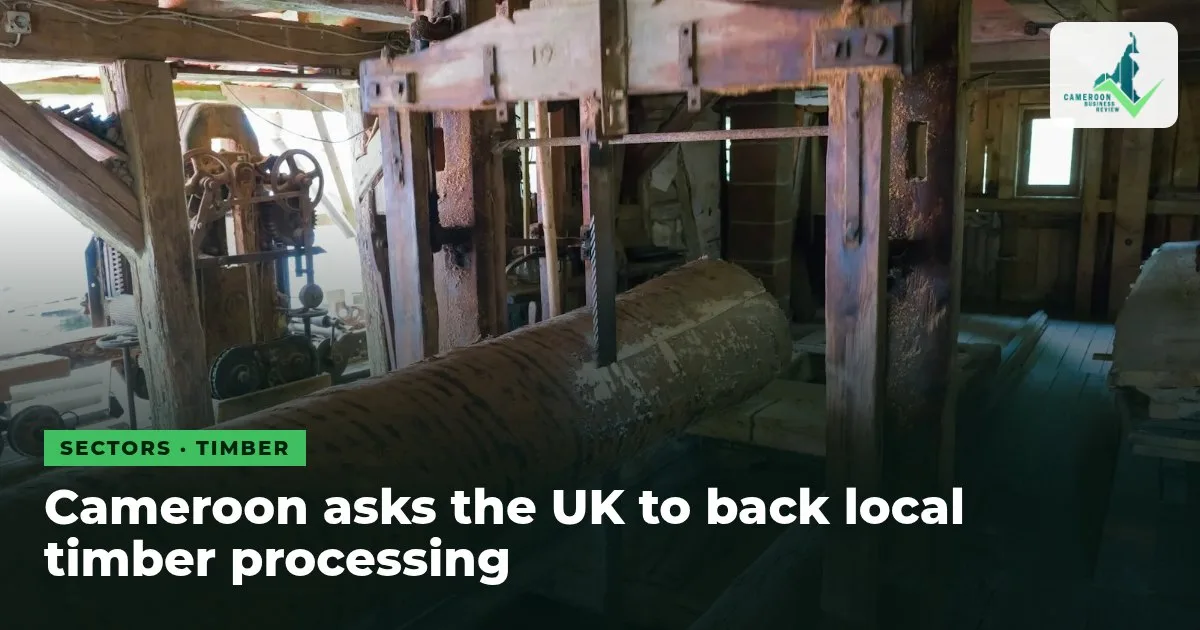
Cameroon wants British money and know-how to help its sawmills and furniture makers process more wood at home. Cameroon timber processing was the subject of talks between the Minister of Small and Medium-Sized Enterprises, Social Economy and Handicrafts (MINPMEESA), Achille Bassilekin III, and a UK delegation, the ministry announced on 20 October, Business in Cameroon's Mercy Fosoh reported.
No money was pledged. The ministry has not announced any UK financial or technical assistance agreement, and no timetable was set. But the talks come as Cameroon and its CEMAC neighbours prepare to restrict raw log exports from 1 January 2028, which will force the industry to add value locally or lose sales.
Who was in the room
The British side was led by Neil Scotland, Senior Forestry Adviser at the UK's Foreign, Commonwealth and Development Office (FCDO). He was joined by Samantha Smith, Deputy British High Commissioner and Chargé d'Affaires, and Euan McCarthy, the FCDO's Regional Climate and Environment Adviser for Central Africa.
According to the ministry, the discussion covered:
- bilateral cooperation on local timber processing;
- support for small and medium-sized forestry businesses;
- upgrading production equipment and transferring technology;
- financing adapted to Cameroonian firms.
The focus on SMEs matters. Large, often foreign-owned, forestry concessions already run industrial sawmills. The gap is further down the chain, among the small workshops that turn sawn wood into doors, furniture and building materials and that struggle to get credit for modern machines.
Cameroon timber processing in numbers
Data from the National Institute of Statistics (INS) for 2025, cited by Business in Cameroon, show how far the shift from raw logs has already gone:
- Sawn timber exports: 762,007 tonnes, worth CFA157.6 billion.
- Raw log exports: 349,611 tonnes, their lowest level in five years.
In tonnage terms, Cameroon now exports more than twice as much sawn wood as raw logs. Sawn timber is only the first step of processing, though. Most of the value in wood products comes later, in drying, planing, joinery and furniture, where Cameroonian firms are still small.
A policy built on taxing logs
The government has used tax to push processing at home. Export duties on raw logs rose from 17.5% to 75% of their free-on-board value between 2017 and 2024. At the same time, customs exemptions were introduced on imported wood-processing equipment, to make it cheaper for local firms to buy machines.
The 2028 CEMAC deadline
The bigger change is regional. A restriction on raw log exports is planned across the Central African Economic and Monetary Community (CEMAC) from 1 January 2028. Business in Cameroon did not give details of its scope, but any regional curb would remove the option of selling unprocessed logs abroad from Cameroon, Gabon, Congo, the Central African Republic and Equatorial Guinea at the same time. That raises the stakes for building processing capacity in the next 14 months.
The Lomié wood park
The UK talks follow a local step. On 6 October 2026, MINPMEESA and the Lomié Council in the East Region signed a partnership to develop the SMEs Wood's Park. The project aims to support timber-processing SMEs, artisans and social economy groups, with goals of local manufacturing, job creation and higher-value products. The East is one of Cameroon's main forest regions, so a cluster there would sit close to the raw material.
Finance and equipment are what the park needs to work, which is where the UK conversation comes in. The FCDO has a long-running interest in forest governance in the Congo Basin, though the ministry did not say which UK programme, if any, might fund Cameroonian SMEs.
What it means for business
For timber SMEs, the message is that support may be coming but is not yet on the table. For exporters, the 2028 deadline is the date to plan around. Moving goods also matters: much of Cameroon's wood leaves through Douala, where the port authority is chasing new traffic, as we reported on the Douala port's bid for Burkina Faso transit cargo.
Three questions will decide whether the talks lead anywhere:
- Will the UK name a programme and a budget for Cameroonian forestry SMEs?
- Will local banks lend against equipment for small processors, or will finance have to come from donors?
- Will the CEMAC rules for 2028 be published early enough for firms to invest?
Until a funding agreement is announced, the talks are a signal of intent, not a deal.
Source: Business in Cameroon, "Cameroon, UK Discuss Financing and Technology for Local Timber Processing", Mercy Fosoh, 21 October 2026, citing MINPMEESA and the National Institute of Statistics.