Cameroon Targets CFAF 4 Billion a Month From New Industrial Power Demand
Cameroon is looking to turn rising industrial electricity demand into a new source of revenue for a power sector that has been struggling with a persistent financial gap.
The government plans to connect about 150 MW of additional industrial electricity demand, mainly around major consumption centres in Douala. If the projected demand is sustained, the new connections could generate nearly CFAF4 billion in additional electricity revenue every month, or about CFAF48 billion a year.
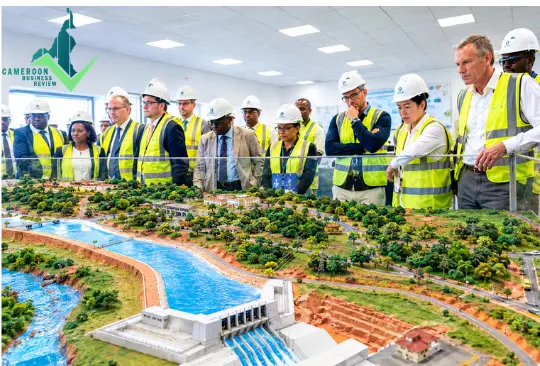
The target was highlighted on October 6 during a visit to the Nachtigal hydropower plant by Water and Energy Minister Gaston Eloundou Essomba and European Union Ambassador Veronika Bošković Pohar, alongside EU member-state ambassadors, development partners and officials from Nachtigal Hydro Power Company.
For Cameroon, the calculation is fairly direct: more industries connected to the grid means more electricity sold. But getting that additional 150 MW to factories is proving just as important as having electricity available to generate in the first place.
The power is there. The network is the problem.
Nachtigal has an installed capacity of 420 MW and has produced more than 4 terawatt-hours since its first generating units came into service in 2024, according to the Ministry of Water and Energy.
Yet the full economic benefit of that generation depends on transmission and distribution infrastructure.
The government is therefore completing electricity transmission and distribution works intended to carry additional power towards major industrial consumption areas, particularly in Douala.
This has been a recurring issue since Nachtigal began operating.
In September, the Ministry of Water and Energy told an IMF delegation that several sections of the transmission corridor towards Douala were at advanced stages and that the government wanted the full corridor completed before the end of 2026.
The situation illustrates an important distinction in Cameroon’s electricity market: installed generation capacity does not automatically translate into electricity that factories can reliably use.
Transmission capacity, distribution networks and connections to industrial sites all have to keep pace.
Douala is at the centre of the new demand
The additional 150 MW is particularly significant because much of the demand is coming from Cameroon’s industrial base around Douala.
The economic capital hosts a large concentration of manufacturing and processing companies, including food and beverage producers, chemical manufacturers, metal processors and other energy-intensive businesses.
Some of these companies have been waiting for dedicated infrastructure that can provide more stable electricity.
In 2024, the Ministry of Water and Energy launched tenders for high-voltage infrastructure intended to supply several industries in Douala, Souza and Dibamba. The projects included connections for companies in sectors such as steel, chemicals, food processing and other manufacturing activities.
The objective is not simply to put more electricity into the general grid.
Dedicated or strengthened industrial connections can help reduce some of the problems created when large industrial loads share infrastructure with residential and commercial consumers.
For manufacturers, that can make a significant difference to production planning.
CFAF4 billion matters because the electricity sector needs cash
The revenue target comes at a difficult time for Cameroon’s electricity sector.
The government is currently implementing a 2026–2028 restructuring programme following the transformation of Eneo into the state-owned Société Camerounaise d’Électricité (SOCADEL) in May 2026.
MINEE estimates SOCADEL's financial debt at more than CFAF800 billion.
The company also secured a CFAF200 billion financing mandate from local banks in August. Of that amount, CFAF50 billion was intended as a revolving facility for liquidity requirements, while CFAF150 billion was earmarked for medium-term refinancing of existing bank and supplier debt.
The sector's underlying cash-flow problem is substantial.
The IMF's 2026 assessment said the electricity utility had been collecting around CFAF31 billion per month against obligations of approximately CFAF44 billion. That leaves a monthly gap of roughly CFAF13 billion.
Against that background, the proposed CFAF4 billion in additional monthly industrial revenue is not insignificant.
It would not solve the sector's financial problems on its own, but it would provide a recurring revenue stream from customers that consume large amounts of electricity.
Industrial demand is growing faster than supply
There is another side to the equation.
Cameroon cannot simply connect every new industrial customer without adding or reinforcing generation and transmission capacity.
During discussions with U.S. banking group Citi on September 29, MINEE presented projections showing that the country's electricity deficit could reach:
130 MW in 2027
250 MW in 2028
400 MW in 2029
500 MW in 2030
Those figures assume new generation capacity is not brought online in time.
The government is therefore pursuing several measures at once.
These include an emergency 200 MW solar programme, rehabilitation of existing generation facilities, additional hydroelectric capacity and possible expansion of gas-fired generation.
At the same time, around 150 MW of new industrial demand is being prepared for connection by July 2027.
This creates a delicate balancing act.
More industrial customers can improve the electricity sector's revenues, but those customers also increase demand on a system that is already expected to face shortages if additional capacity and transmission infrastructure do not arrive on schedule.
The industrial economy has something to gain too
For manufacturers, the importance of the programme goes beyond the electricity company's balance sheet.
Reliable electricity affects production volumes, machinery utilisation, operating costs and investment decisions.
A factory that cannot count on stable power may have to rely on generators, reduce production during interruptions or delay plans to increase capacity.
That can make locally produced goods more expensive.
The government has therefore been trying to improve the infrastructure serving industrial users, particularly around Douala.
The IMF has also linked electricity bottlenecks to Cameroon's broader economic performance. In its recent assessment, the Fund said delays in increasing electricity transmission capacity were among the factors weighing on the country's 2026 outlook.
This is why the 150 MW target is relevant beyond the energy ministry.
If the connections work as planned, the beneficiaries could include manufacturers, suppliers, transport companies and other businesses whose activity depends on industrial production.
Recovering lost revenue is another part of the plan
New industrial connections are only one part of the government's revenue strategy.
Electricity fraud is another major source of losses.
MINEE estimates that electricity fraud costs the sector more than CFAF60 billion a year. Initial enforcement operations have generated approximately CFAF500 million in additional monthly cash flow, according to the ministry.
The government is also preparing a permanent anti-fraud committee, with a draft decree currently under review.
Meanwhile, around 250,000 prepaid meters have been ordered with World Bank support to improve consumption measurement, reduce unpaid electricity and limit some forms of fraud.
These measures point to a broader approach: increase revenue not only by selling more electricity, but also by collecting more of what is already being consumed.
The cost side is still a problem
Improving collections will not be enough if the sector's costs continue to outpace its revenues.
The government is discussing the potential restructuring of its interests in Kribi Power Development Company (KPDC) and Dibamba Power Development Company (DPDC) with Globeleq.
MINEE says the proposed transaction could reduce electricity billing costs by around CFAF3.5 billion.
The government is also working with the Ministry of Finance on payments to Nachtigal Hydro Power Company and the replenishment of the sector's letter of credit mechanism.
These steps are important because the electricity system involves large fixed financial commitments, including payments for generation capacity.
The IMF has previously warned that the structure of the Nachtigal power purchase agreement could add to fiscal pressure when transmission constraints prevent the country from fully using available generation.
What this means for investors and manufacturers
For businesses considering investment in Cameroon, the electricity story is becoming increasingly important.
The country has added substantial generation capacity in recent years. Government figures put total installed generation capacity at approximately 2,280 MW at the end of 2025, compared with 1,516 MW in 2020. Nachtigal alone represents roughly 18% of the current installed capacity.
The next question is whether the transmission and distribution system can deliver that power where it is needed.
For industrial investors, several indicators will therefore be worth watching:
Transmission projects: Completion of the corridor carrying Nachtigal power towards Douala will determine how much of the available generation can reach the country's largest industrial centre.
Industrial connections: The planned 150 MW of additional demand will show whether new infrastructure can translate into actual electricity sales.
Generation capacity: The expected increase in demand means Cameroon will need new generation alongside the current infrastructure.
Sector finances: SOCADEL's ability to refinance its debt and improve collections will influence the sector's capacity to maintain and expand the network.
Electricity reliability: For manufacturers, the value of additional capacity ultimately depends on how consistently they can receive it.
Final Thoughts
Cameroon's plan to connect 150 MW of new industrial electricity demand has two sides.
For industry, it could provide access to more reliable power and remove one of the constraints on expanding production.
For the electricity sector, it represents a potential CFAF4 billion in additional monthly revenue, or close to CFAF48 billion a year if the demand is sustained.
But the numbers also expose the scale of the challenge.
Cameroon is trying to increase electricity sales while repairing a sector with substantial debt, weak cash flow, infrastructure bottlenecks and continued losses from fraud.
The success of the industrial connection programme will therefore depend on more than putting new factories on the grid. The country needs to make sure the power can reach them reliably, that the electricity is paid for, and that new demand is matched by enough generation capacity in the years ahead.
For Cameroon’s industrial economy, that connection between power supply, production and sector finances may be more important than the CFAF4 billion headline itself.
Cameroon Business Review will continue to track how the electricity restructuring programme affects industrial investment, manufacturing costs and business activity across Cameroon.