Cameroon Takes Its Cocoa and Coffee Investment Pitch to Rome. What Comes Next?
Cameroon is taking its cocoa and coffee industries to an international audience, hoping that recognition for its products will translate into stronger investment across both value chains.
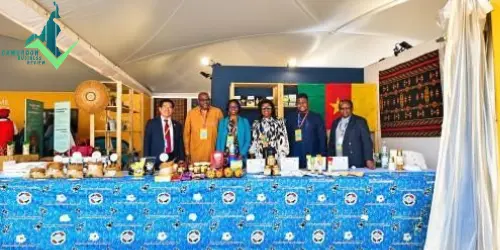
At the World Food Forum 2026, held from October 8 to 16 at the Food and Agriculture Organization’s headquarters in Rome, the National Cocoa and Coffee Board (ONCC) presented Cameroonian products and highlighted investment opportunities in the two sectors.
The delegation, led by ONCC Director General Michael Ndoping, offered coffee tastings featuring varieties from different parts of Cameroon. Its exhibition also included chocolate, cocoa pods, and green and roasted coffee beans. Visitors could obtain information about investment opportunities across the cocoa and coffee value chains.
The exhibition comes after several international awards for Cameroonian cocoa and coffee in 2026. Those results give the country a useful platform for attracting buyers and investors. But awards and product tastings are only the beginning. The larger economic question is whether Cameroon can turn international interest into investment, competitive processing businesses and better opportunities for producers.
Why Cameroon is promoting cocoa and coffee abroad
Cocoa and coffee are established agricultural commodities in Cameroon, supporting farmers, cooperatives, traders, exporters and processing companies. Their economic contribution, however, depends on more than the volume harvested and exported.
Quality, consistency, processing capacity, access to buyers and the ability to meet international market requirements all influence the prices producers receive and the value businesses retain.
The Rome exhibition was an opportunity to present Cameroonian products directly to an international audience while making the case for investment in the activities surrounding production.
For cocoa, that can include fermentation and drying, quality control, storage, transformation into chocolate and other products, packaging and export logistics. In coffee, opportunities extend from processing and grading to roasting, branding and distribution.
These activities require different levels of capital and expertise. Some are suitable for cooperatives and smaller businesses, while others need industrial equipment, reliable electricity, working capital and established distribution networks.
For investors, the appeal is not simply access to raw agricultural products. It is the possibility of building businesses around products that can be differentiated by origin, quality and processing.
For Cameroon, the challenge is to ensure that investment creates stronger domestic businesses rather than leaving the country dependent on selling commodities with limited processing.
International awards give the sectors a stronger sales pitch
Cameroon's presence in Rome followed a series of recognitions that could help raise the profile of its cocoa and coffee.
On February 20, 2026, the SCCAPCC cooperative from Kye-Ossi, represented by François Atangana Onana, won a gold medal in the Africa and Indian Ocean category at the Cacao of Excellence Awards in Amsterdam.
Earlier that month, Cameroon placed first in the natural robusta category and third in the women-produced natural robusta category at the African Taste of Harvest 2026 competition in Addis Ababa, Ethiopia.
The country had also been recognised in 2023 by the International Cocoa Organization as a producer of fine or flavour cocoa. That classification is important, but it should not be interpreted as applying automatically to every cocoa bean produced in Cameroon.
Together, these achievements offer exporters and producers a way to demonstrate quality to prospective buyers. They may also help cooperatives and companies distinguish their products in markets where buyers have a choice of origins.
However, an award-winning sample does not establish the quality of an entire national harvest. Maintaining a reputation requires consistency from one production season to the next, supported by appropriate harvesting, fermentation, drying, storage and quality-control practices.
The ONCC attributes the recent progress to more than a decade of efforts by public authorities and industry stakeholders to improve the quality of Cameroonian cocoa and coffee.
The next task is to make that progress commercially valuable for more producers and businesses.
Local processing is where the investment question becomes concrete
The promotion in Rome comes amid a wider government push to attract investment into domestic cocoa and coffee processing.
On October 6, Trade Minister Luc Magloire Mbarga Atangana called for greater Japanese investment in local processing during discussions with Koume Tomoyoshi, an industrial development official at the United Nations Industrial Development Organization (UNIDO) and head of the PICS project.
The three-year PICS programme, funded by Japan, is backed by a financing agreement worth $2.2 million, approximately CFAF 1.3 billion, signed in March 2024 between UNIDO and the Japanese Embassy in Cameroon.
According to the Ministry of Commerce, more than 800 participants in the cocoa and coffee value chains have received training, while 18 cooperatives have received equipment to improve their operations. The programme has also supported quality assessment, certification initiatives and efforts to connect local operators with international buyers.
During the October discussions, the minister called for an investment component that would encourage Japanese companies to establish processing facilities in Cameroon. He also sought an extension of the programme and stronger access for Cameroonian cocoa and coffee to the Japanese market.
The distinction matters. Training and equipment can help producers improve their products, but industrial investment requires additional commitments: financing, dependable supplies of raw materials, skilled workers, suitable infrastructure and buyers for finished products.
Processing locally can create employment in manufacturing, packaging, maintenance, transport and distribution. It can also give businesses more opportunities to sell products with greater value added than unprocessed beans.
Yet a processing plant is only commercially viable when it can operate consistently and sell what it produces. Investors will need confidence in raw-material supply, quality standards, energy availability, logistics and market access.
That is why the international promotion effort should be viewed alongside the work required to make investment projects viable at home.
Meeting international standards remains essential
Access to international markets increasingly depends on more than product quality alone. Buyers also want reliable documentation, traceability and evidence that commodities meet applicable environmental and other regulatory requirements.
For cocoa exporters serving Europe, traceability is particularly important. In 2024, Cameroon launched a platform intended to help European buyers obtain geolocation information for cocoa plantations through an initiative involving the Cocoa and Coffee Interprofessional Council and major exporters.
Reuters reported at the time that the European Union accounted for around 80% of Cameroon's cocoa bean exports in the 2023–2024 season, making compliance a significant commercial concern.
For producers and exporters, traceability systems can require data collection, farm mapping, recordkeeping and coordination across supply chains. Smaller operators may need technical and financial assistance to meet those requirements.
Investors considering processing or export operations will also want confidence that their suppliers can deliver compliant products consistently.
The Rome exhibition can introduce Cameroonian products to new contacts, but converting those contacts into lasting business relationships will depend on the country's ability to demonstrate quality, reliable supply and compliance with target-market requirements.
What should investors look for?
The opportunities in cocoa and coffee are not limited to large industrial processing plants. Investment can take place at several points along both value chains.
Potential areas include:
Post-harvest handling and storage: Better fermentation, drying and storage can help protect quality and reduce losses.
Quality testing and certification: Laboratories and specialised services can help producers and exporters meet buyer requirements.
Processing and manufacturing: Cocoa transformation, chocolate production, coffee roasting and packaging can create additional domestic business activity.
Producer and cooperative support: Equipment, training and improved links to buyers can help smaller operators supply more consistent products.
Export services and branding: Traceability, packaging, product differentiation and market development can help companies reach customers willing to pay for quality.
These are potential areas for investment, not a list of confirmed deals announced at the World Food Forum.
For Cameroon to attract capital into them, investment promotion needs to be accompanied by clear project information, credible business plans, realistic supply estimates and evidence of market demand. Investors need to understand not just what the country produces, but where commercially viable opportunities exist and what support or infrastructure those projects require.
The government and industry bodies also have a role in ensuring that smaller producers are not excluded as the sectors become more quality-driven and commercially organised.
Final Thoughts
Cameroon's presentation at the World Food Forum gives its cocoa and coffee industries another opportunity to reach international buyers and investors. The recent awards provide a useful starting point, while the PICS programme shows that work on quality, equipment and market access is already under way.
But visibility alone will not expand the country's share of value from these commodities.
The more important test is whether international interest leads to investment in processing, stronger producer organisations, dependable quality systems and businesses capable of competing in export markets.
For Cameroon, the objective should be clear: sell products that buyers want, make it easier to invest in the businesses behind them, and retain more of the resulting economic value within the country.
That is how a successful exhibition can become a lasting commercial result.